Pubs and Breweries in Gloucestershire Past and Present
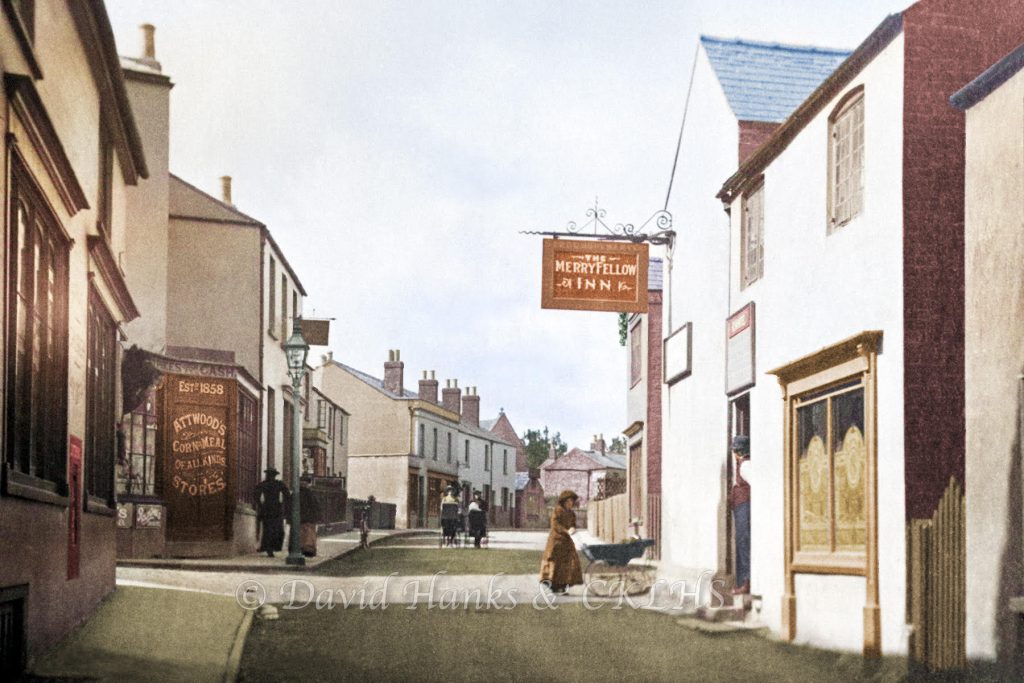
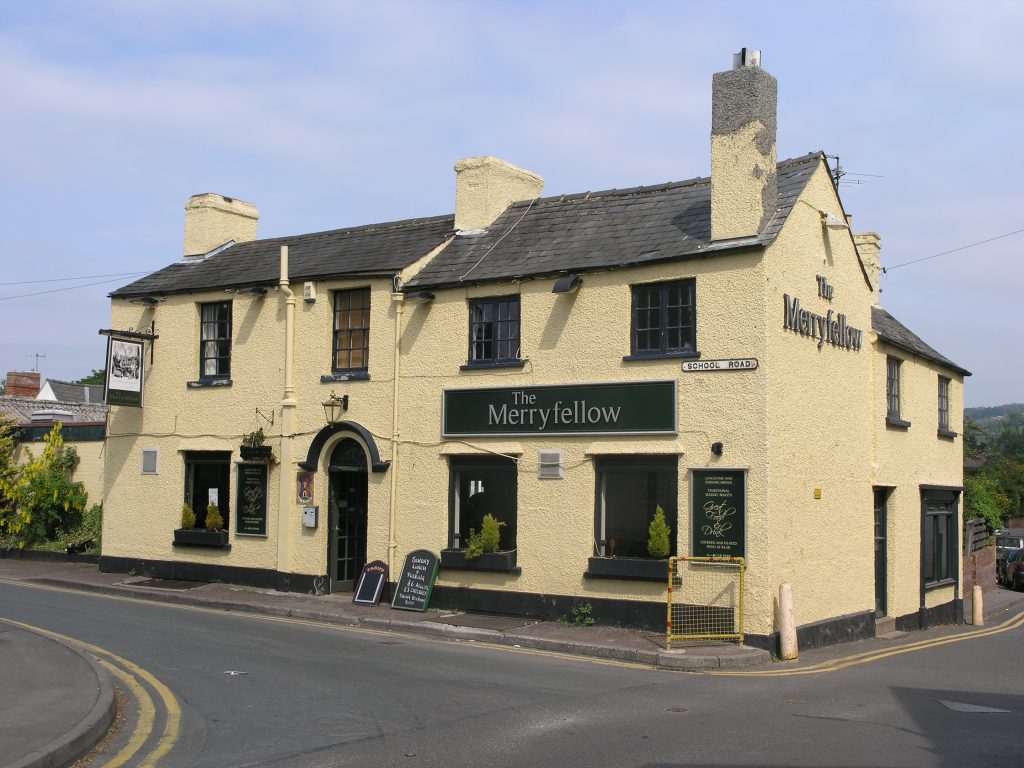
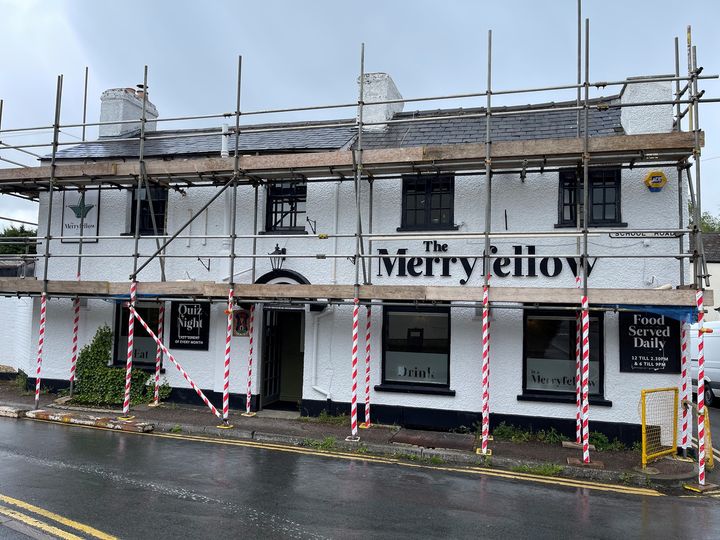
Merryfellow Inn, 2 School Road, Charlton Kings, Cheltenham
The Merryfellow Inn is on the corner with School Lane and Church Road.
Courtesy David Hanks, Charlton Kings Local History Society
The following information courtesy of Alan Jones:
When the Merry Fellow moved from Cudnall Street / Brookway Road junction to School Road (Mill Lane as it was) in 1858, at first there were two cottages there, and although Samuel Hogg purchased both, the pub only occupied one and he lived in the other. The 1858 Rate Book for Charlton Kings describes them as “beer house and cottage both owned and occupied by Samuel Hogg (gross estimated rental £15 and £2. 10s. 0d.).” This from Behing The Merry – from School Road to Hearne Brook by Mary Paget in CKLHS Bulletin no. 37 from 1999.
Apparently, it became known locally as the “Nowhere pub,” because the village police station was moved from Horsefair Street to Church Road in the late 19th century especially to maintain order with it and another nearby pub or two (The Prince of Wales and the Endeavour Inn). The Stroud Brewery ale that the Merry Fellows – and presumably the others – sold, was known as “fighting beer,” whereas the Cheltenham ale sold at The Royal Hotel (colloquially known as “The Monkey House” because of the monkey kept chained to a 30ft pole in the garden) was known as “singing beer.”
Next to the Merryfellow’s car park at 10 School Road is a Grade II Listed Building called Charlton Cottage. At one time, there used to be further cottages beside the pub. In the article quoted above Mary writes, “It is hard to believe that on the [area] used by the Merry Fellow as car park and skittle alley there were once seven dwellings.” In an earlier article entitled Charlton Cottage, 10 School Road, Formerly Called Joyce’s” also by Mary in CKLHS Bulletin no. 15 from 1986, she features an architectural report on the building by Linda Hall, and explains that the old building next to Crab End Cottage was split into 3 dwellings, “the inter-relationship of the three was so complicated it became known as The Puzzle House!” (There are revisions of the architectural report by Linda Hall in Bulletins 41 and 43). Indeed, in an article entitled Ashley Manor Freeholds – A Clue to Charlton Cottage in Bulletin no. 43, Mary writes, of Charlton Cottage, “cheek by jowl with a carpark, but formerly it was right against a boundary wall of the (demolished) timber-frame and that building known as Crab End Cottage, divided in the 19th century into three dwellings.” You might be wondering why I have gone to so much effort to quote all of this. It is because Mary – whose instincts as a historian are usually very sharp, goes on to suggest that Crab End Cottage was “possibly an ale house, with the detached stone building, Crab Stones, its brewhouse.”
This intrigued me, so I searched all the directories I could get access to…and sure enough in the 1844 Harper’s Directory I found a beerhouse listed in School Road called The Mason’s Arms, landlord David Denley. This was the only listing I could find, and it had surely closed before the Merry Fellow opened so close by in 1858, so I guess I was lucky to find it listed at all – probably right at the end of its existence. But the interesting and intriguing thing is Mary’s further speculation in her article in Bulletin no. 43, wherein she says that a much earlier owner of Charlton Cottage from the 16th century was John Hicks or Hyxe, and writes: “We ask how a man like Hicks could afford to build or want to build fireplaces in his parlour and parlour chanber of the quality of those which have been discovered at Charlton Cottage |as outlined in the architectural reports previously cited], and live in a house which, though a century old [making it 15th century] was so substantial.” Mary’s further speculation is that, “If he ran an ale-house next door, possibly even a brewery supplying other Charlton ale-sellers as well as his own ale-house, the question is answered.”
It is all circumstantial and speculative…but the “Forge Ale House” did certainly, verifiably exist in Church Road by 1608 (there are records of William Crumpe, the landlord, being fined in the Manor of Cheltenham Court Books going back to then (1st April View of Frankpledge and Court Baron – fined 12d. for permitting “illicit games” in his house). So maybe another ale house of similar age is not beyond the realms of possibility. Stonemasonry is certainly an old enough trade for it to have been named such…but even if both the pub and the name came later, we can now be sure that a Mason’s Arms existed there – probably at the end of its existence – in 1844.
Hi Geoff,
The following was reported in the 4th December 1902 edition of the Gloucester Citizen in relation to charges of drunkenness and a publican permitting drunkenness at the Merryfellow Inn in Charlton Kings – a bit of an extreme case.
The report is long, so I have precised in parts.
“At the Cheltenham Police-court on Thursday, before Colonel Godfrey and other magistrates, James Wood, florist and nurseryman, of Charlton Kings, was summoned for being drunk at the Merryfellow Inn on the 26th November. – Defendant pleaded guilty. – Superintendant Hopkins stated that the prisoner was found unconscious from drink lying on his back in an unused room, the door of which was locked. He was so bad that a doctor was sent for, and for a time it was thought Wood might die. It was a long time before defendant could be removed. – Fined 10s. and costs (£1. 7s. altogether).
Charles Webb, landlord of the Merryfellow Inn, Charlton, was then summoned for permitting drunkenness on his premises on November 26th. Defendant pleaded not guilty. – Mr. A. Lamb defended.
Apparently the police had already warned publicans in Charlton Kings that Wood was “much addicted to drink.” P.C. Smith reported that he saw Wood in the tap-room of the pub at 2.20 “in a drunken condition swaying about in his seat.” Witnesses then brought Seregeant Day to the pub around 3.30, which is when Wood was discovered locked in the smoke room, which was unused because it was being renovated, led out unconscious on a pile of coats with a cushion under his head.
Webb, the landlord, contended that Wood had gone into the pub at 9 am, was served 3 pints and left around 12.30. Apparently he was then seen around the village drinking a bottle of Scotch. When he returned to the Merryfellow in the afternoon, he wasn’t served any more drink, and when he started to fall asleep – presumably around the time P.C. Smith saw him in the tap-room swaying – he was removed to the smoke-room, lain on the coats and pillow and locked in to sleep it off and sober up.
The sergeant testified that he didn’t believe Wood could have been in the condition he was discovered in at 3.300 if he had been seen sitting up at 2.30 (presumably without being served more drink). It appears Wood was so out of it that the doctor who was called wouldn’t let him be moved until 7.15, and then he was carried home on a stretcher!
Webb, the landlord of the Merryfellow was “Fined £5 and costs” and had his licence endorsed!
I guess the magistrates believed Sgt. Smith more than Charles Webb. Perhaps the landlord in this instance suffered because of the pub’s reputation for serving “fighting beer” – it being one of the reasons the local police station was moved from Horsefair Street to be closer to the more troublesome triumvirate of pubs in the Merryfellow locality. Seems a bit harsh to me when the witness to Wood being sat up (albeit swaying drunkenly) at 2.30 was another policeman and he had been seen swigging Scotch from the bottle
I don’t think Webb could have realised just how out of it Wood was when he locked him in the unused smoke room, and thought he was doing the right thing. Still, how does the saying go? – No good deed goes unpunished.
Cheers,
Alan Jones
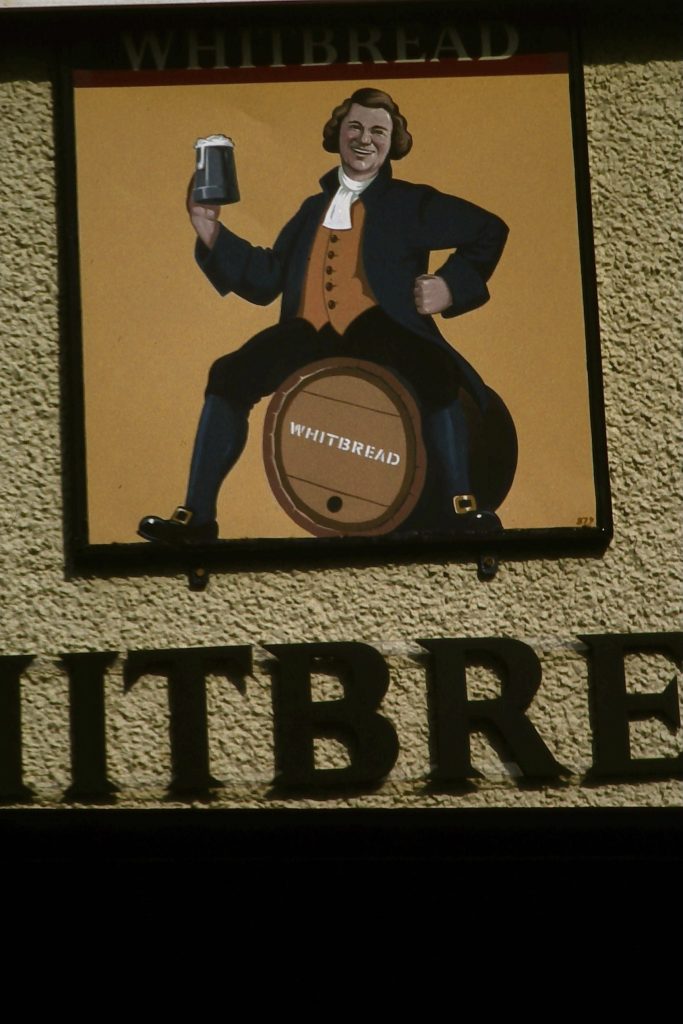
Gloucestershire Echo, 12th December 1975 – Gloucestershire’s oldest man, Mr Charlie Wilmot, of Grevil House, Charlton Kings was 105 yesterday and was given that number of bottles of barley wine by Whitbread Flowers. Still active and alert, Mr Wilmot received his gift at the Merryfellow Inn, where he is a regular customer. Ken Booth, the landlord, said Charlie was “a great character and a great favourite with the locals.”
Courtesy Michael Wilkes Gloucestershire Echo, Monday 20th March 1989 – The Merryfellow (advertising feature): Moving from St. Helens, in Lancashire, to the rural surroundings of Charlton Kings was a decision taken nearly a year ago by Gary and Marie Blower – and it is a step which they have certainly not regretted. Since last May they have been mine host and hostess at the Merryfellow Inn, right in the centre of Charlton Kings, after deciding they wanted a complete change of job and environment. Says Gary: “We were offered a number of pubs in the area, and this was probably the most run down, but we felt that it had plenty of potential for developing as a village inn.” Now they are celebrating the transformation of the pub into a real village centre, where the locals come along and enjoy a chat and a drink in comfortable suroundings, which are throughly in keeping with the village. Extra room for customers has been gained by moving the kitchen to another area and using the space for a darts room. Most interesting are the pictures on the walls illustrating aspects of life in the village years brought into the inn by a customer. The design of the bar and lounge area is the work of Mrs Blower, with new furnishing and carpets. Details of the history of the pub are given on one of the walls, and it seems that the original Merryfellow Inn was in another part of the village. Eventually it moved to its present site in 1848, when two cottages were joined together. New toilets and kitchens have been installed and the skittle alley, previously away from the main building, has been joined to the inn, and will be the scene of many games in the future on the renovated alley.
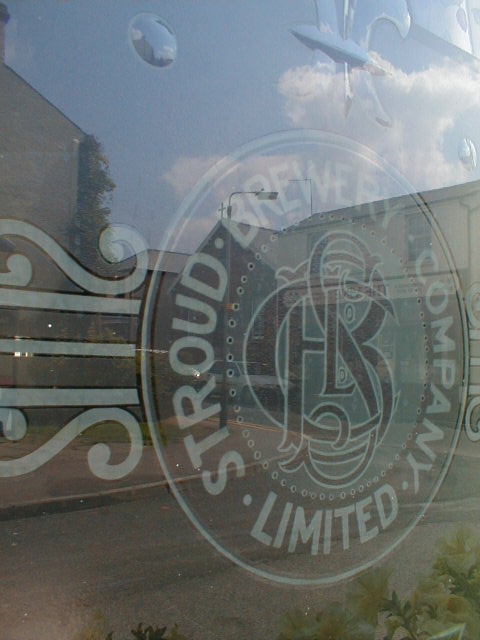
The Merryfellow had a long association with the Stroud Brewery being one of the few pubs in the area to be tied to the brewery in 1891. Until the Summer of 2004 the Merryfellow boasted two original Stroud Brewery Company etched windows. Unfortunately, these superb windows were needlessly smashed by vandals and have been replaced by ordinary clear glass.
Courtesy The Merryfellow
Licensing Details:
Owner in 1891: Watts & Co, Stroud Brewery
Rateable value in 1891: £15.5s.0d.
Type of licence in 1891: Beerhouse
Owner in 1903: Stroud Brewery
Rateable value in 1903: £17.10s.0d.
Type of licence in 1903: Beerhouse
Closing time in 1903: 11pm
Landlords at the Merryfellow Inn include:
1858 Samuel Hogg
1876 and 1878 John Cooke (Royal Directory)
1891 Thomas Edwin Attwood
1902 W.G. Wagstaff (Annuaire)
1903 C. Webb (Annuaire)
Gloucester Citizen, Monday 12th January 1903: ‘The license of the Merryfellow Inn was temporarily transferred from Charles Webb to Richard F. Smith. Webb was find £5 for permitting drunkenness on his premises in December, and the transfer was granted without prejudice – the licensing justices being left a free hand in the matter at the Brewster sessions.
1903 Richard Frank Smith
1904 – 1906 R.F. Smith (Annuaire)
1907 – 1912 Mr. R. White (Annuaire) Also 1913 to 1916 (Looker-On)
1922 and 1925 Mrs. E. White (Built-Leonard) also 1926 and 1927 Mrs. Elizabeth White (Kelly)
1926 Mrs Elizabeth White
1928 – 1945 Thomas Henry Dyer (Kelly)
Cheltenham Chronicle, Saturday 1st November 1941 – The funeral took place on Thursday week at St. Mary’s Church, Charlton Kings, of Mr. Thomas Henry Dyer, of The Merryfellow Inn, Charlton Kings. Amongst the family mourners was Mrs Sara Dyer (widow). The Stroud Brewery Co., Ltd. was represented by Mr. R. Wakefield.
1947 ‘Transfer of the licence of the Merryfellow from Mrs Sara Dyer to John Albert Child was granted.’
1948, 1950, and 1952 John Albert Child (The Childs were there through 1973)
1950 John Albert Child
1975 Ken Booth
1988 Gary and Marie Blower
2003 James Dockree
2009 Lynne Kane (manager)
2009 Heidi and Ken Willsher
2010 Joanne McRoberts
2011 Parry Preece
2013 Martyn Herbert and Caite Jones
2015 Cathy Searle and Nigel Ball
2015 (November) Kelly and Ian Baikie (from the Haw Bridge Inn, Tirley)
2024 (Dec) Ian & Stacy Lander
The following notes are from Alan Jones:
The Merry Fellow – the first iteration of what would relocate to become the Merryfellow in Church Street. Mary Paget says in the book that this started off called the Merry Fellow in Cudnall Street and is listed there in the Hunt’s directories of 1844 and 1848 and in the Harper’s Directory of 1857, landlord or owner or both Samuel Hogg. She says it moved from Cudnall Street in 1858. It doesn’t say how long it had existed in Cudnall Street.
She talks a bit about location, and though it is a little confusing this is picked up on in CKLHS Bulletin no.23 (1990) by Gwen Tovey who writes of the information on pg. 148 of A History of Charlton Kings, “The 1851 census suggests to me that those 3 cottages were then known as 1,2,3, Milford Place: whereas in a (reasonably appropriate) position for what are now 32, 30, 28 Cudnall and 1, 3 Brookway Road (which used until 1870s to be Brookway Place) we find:-
Brook Place – James, tailor and grocer
MERRY FELLOWS – Samuel Hogg, beer seller
Brook Place – Jos. Sallis, carpenter.”
All of which I think means that the Merry Fellow (or Merry Fellows as she quotes it) was in the building at the corner of Cudnall Street and Brookway Place, which was originally 3 cottages with the Merry Fellow being in the first property round the corner (middle one).
I have to say, after reading Mary’s piece initially, I did wander up and down Cudnall Street and that corner was one of 2 likely suspects I had picked out before I came across what Gwen Tovey wrote.
Apparently, when the Merry Fellow relocated (and changed its name to one word instead of two) in 1858, another public house filled the spot, which was called the Ashley Arms, Thomas Nichols landlord. I have not got any info on this one from the directories I can access, but it sounds plausible because Ashley is a family name with great significance in Charlton Kings. Around 1335 Walter of Ashley was rewarded for his support of Matilda’s claim to the throne by a grant from the Manor of Cheltenham (confirmed by Matilda’s son Henry II). Ashley was given £10 worth of land (which incidentally included every other house in Cudnall Street) and Walter of Ashley was the first Lord of Charlton (Ashley) Manor. More work for local history buffs to do to find details re. the pubs – I was most interested in discovering their locations.