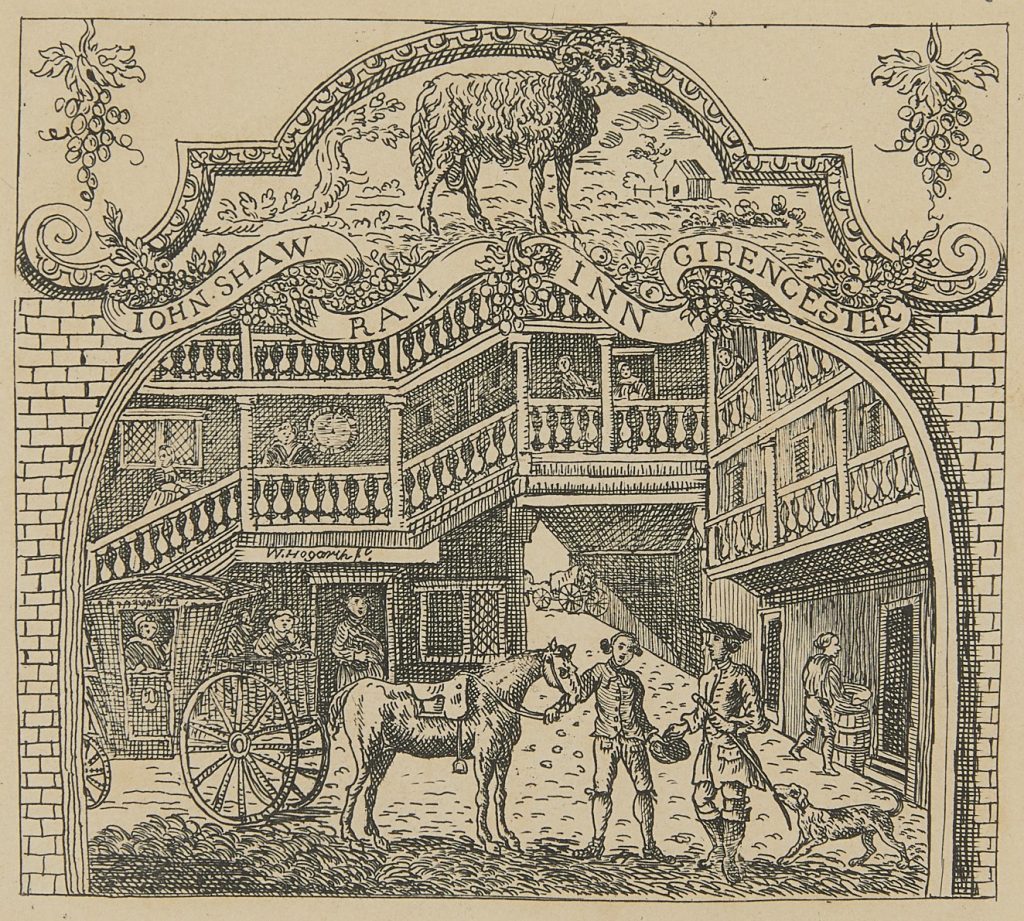
The main coach and vehicle entrance to the galleried courtyard was from Castle Street, where the Ram had a frontage of about 186 feet (60.3m).
In pre-railway days the Ram was probably the most important inn (and later hotel) in Cirencester, but with the decrease of long distance horse drawn wagons and the withdrawal of the cross country Royal Mail stage coaches from Oxford, Bath and Cheltenham, a slow decline in the Ram’s fortune led to it being advertised for sale in 1863. The advertisement for the sale stated that the hotel ‘contained a bar, coffee room, commercial room, three private sitting rooms, smoking room, large market room, 15 bedrooms and extensive kitchens and domestic offices plus underground cellars’. In addition there were ‘stalls and loose boxes for 30 horses’.
By August 1863 the Ram Inn had been bought by the Cirencester Hotel Company for £2,625. The Cirencester Hotel Company also owned the Kings Head. Business must have fallen off even more because an advertisement in the ‘Standard’ in 1875 said that the directors of the Cirencester Hotel Co. had determined to let off ‘a further portion’ of the building having already disposed of some of the property. The Castle Street frontage had been reduced to some 38 feet and 3 inches. (11.7m). The accommodation then consisted of a bar and parlour; one large first floor room; three bedrooms; good attics; kitchen; indoor WC and extensive cellarage.
The front of the Ram looking out on to the Market Place was converted into shops; the site on the corner of the Market Place and Castle Street was let to John Jefferies & Son, the shop next to it was taken by Stradlings. The Ram Inn closed in about 1894/5 when the whole building was pulled down to widen Castle Street and make way for a development of shops and offices commissioned by the Bathurst Estate.
From the notes of John Tiffney
RAM INN
Until 1895 Castle Street was half the width it is today. The north side was taken up by THE RAM INN, the more important of the two hotels in the town. The building stretched from Perry Bishop’s offices in Silver Street round into the Market Place to the Edinburgh Wool Shop. The front of the Ram would have been along the outside line of the present parking and unloading bay. The main entrance was through a large open arch (Where “Timecraft, Jewellers” are today) giving access to a courtyard with stairs going up to the rooms on the first and second floors, very similar to the New Inn in Gloucester and the George Inn, Southwark. On the first floor was a large room, used for meetings of the Masonic Lodge, the Chamber of Agriculture etc.
The ground floor was taken up with stabling for horses for hire and especially for those of the two Mail Coaches that stopped in Cirencester in the morning – (“Breakfast 10mins”) and in the afternoon – (“Dinner -12mins”). The times were those for changing the horses also for the delivery and reception of the Mail bags from the Post Office in Black Jack Street.
After the arrival of the railway into the town in 1841 the mails from London were still carried forward to Gloucester and South Wales by coach until 1845 when the line opened to Gloucester. After 1845 the RAM very slowly fell into decline, and was taken over by the owners of the KINGS HEAD, some of the ground floor frontage in Castle Street and/or West Market Place being turned into small shops.
THE RAM TAP was next to the RAM INN arch, more or less where Tidings card shop and the Old Post Office arch is today.
Licensing Details:
Owner in 1891: Earl Bathurst (leased to Cirencester Brewery)
Rateable Value in 1891: £12.15s.0d.
Type of license in 1891: Alehouse
Landlords / Proprietors at the Ram Inn include:
1820 Robert Tyler
1830 John and Richard Weaver (Ram Inn, Gosditch Street)
1830,1861 James Stevens
1891 Alfred Stallard