Pubs and Breweries in Gloucestershire Past and Present
Welsh Harp, 36 London Road, Gloucester GL1 3NU
There is a reference to the Welsh Harp as far back as 1744 when it was described as being at the location known as ‘Without the Lower Northgate’.
Tewkesbury Register 2nd December 1865:
Caroline Pilley was committed for trial for stealing a cotton chemise belonging to Sarah Beasley. Prisoner, who is an old offender was washing at the Welsh Harp on Tuesday last, and the chemise, belonging to the prosecutrix was missed in the evening. PC Mallett took prisoner into custody and found the chemise at Mrs Healey’s in Church Street, she having bought it off the prisoner for 10d
Gloucestershire Chronicle. Saturday February 26th 1870. Welsh Harp Inn, London Road, Gloucester. Messrs Townshend & Co have received instructions to sell by auction (without reserve), on Tuesday March 22nd 1870 at eleven o’clock precisely,- the whole of the very good, useful, well made and almost new household furniture, stock in trade, brewing plant, malt mill etc. Catalogues to be obtained at the auctioneers office the day previous to the sale.
Quarter sessions at Tewkesbury 29 Dec 1865:
Caroline Pilley, Stealing one Cotton chemise the goods and chattels of Sarah Beasley. Imprisonment and hard labour for three Calendar months at Gloucester jail
Courtesy Reg Woolford Collecton
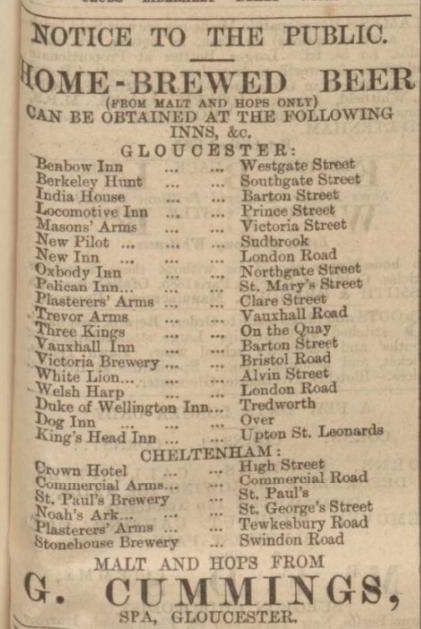
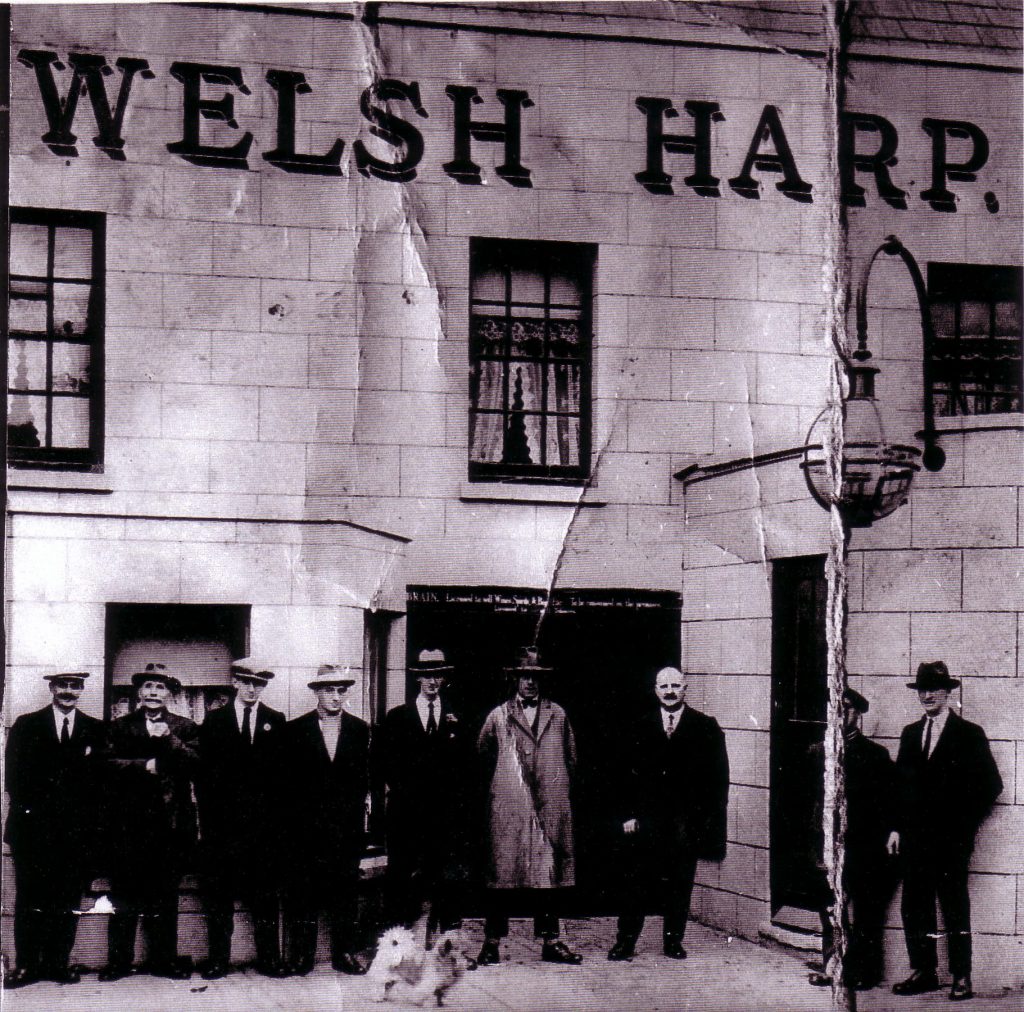
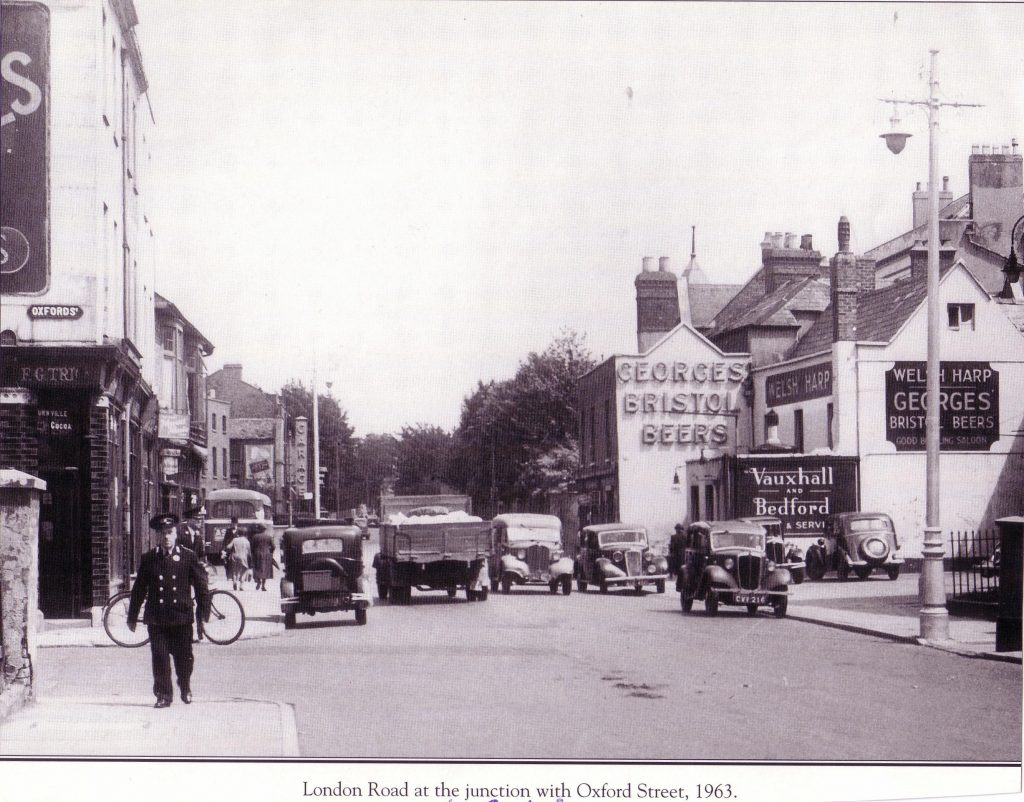
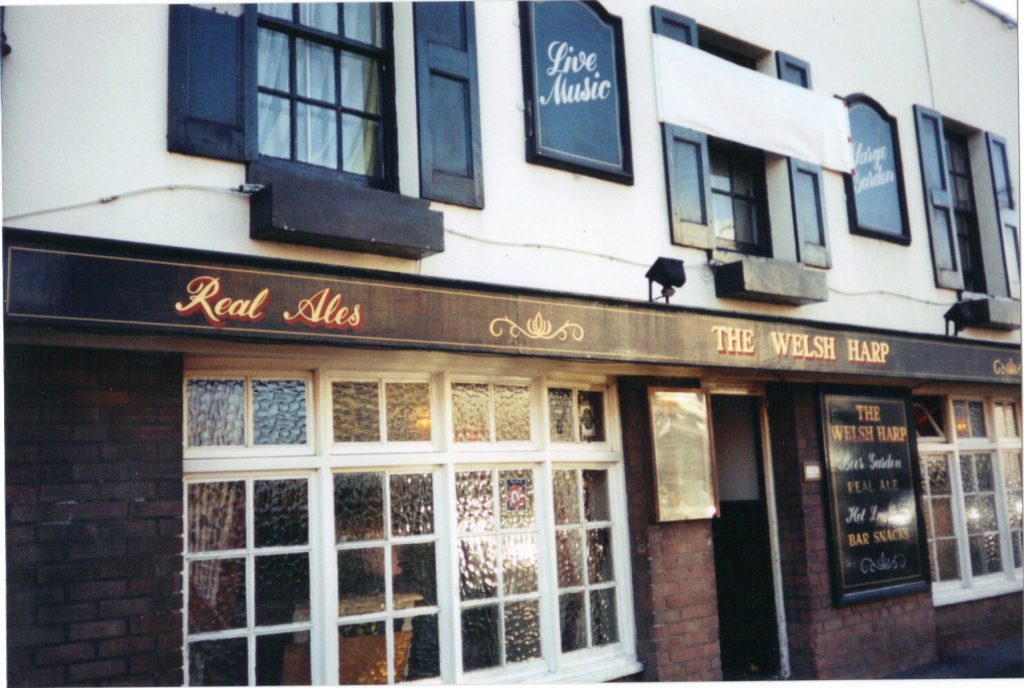
The facade of the Welsh Harp has been substantially altered over the years. A photograph of the pub taken in the 1920’s when Grantley Brain was the landlord shows it to be rendered with a brick pattern etched into the plasterwork. At ground level there are possibly two bay windows. The name the ‘Welsh Harp’ is painted on the building above the upper floor windows in highlighted lettering. The modern frontage of the pub has no bay windows. The Welsh Harp was a tied house of Francis Wintle, Forest Brewery, Mitcheldean. In 1963 the Welsh Harp was selling beer from Georges’ Bristol Brewery. It later became a Courage pub.
Courtesy Reg Woolford Collection
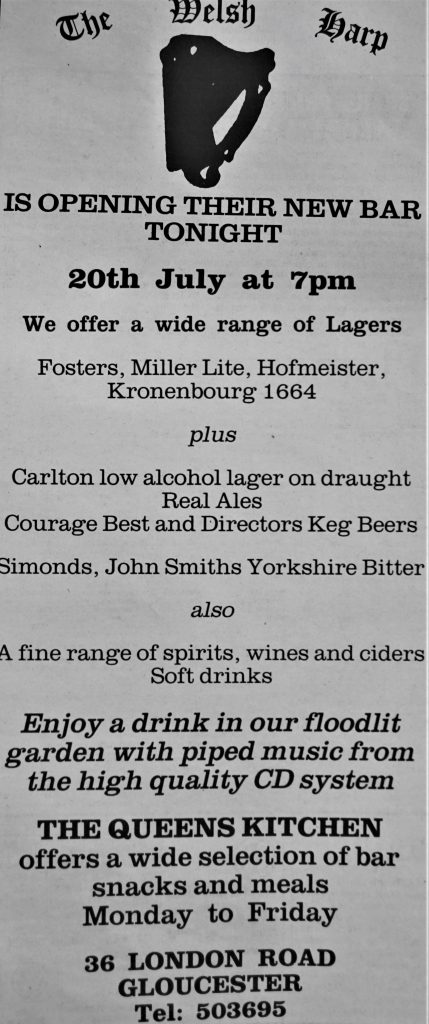
The Citizen. Advertisement Feature – Wednesday, July 19th, 1989 – It’s better than ever: The Welsh Harp, a traditional, homely-looking pub m London Rod, Gloucester, is a bit like Doctor Who’s Tardis. Not, we hasten to add, because it will fly away at the touch if a button, but because it’s a lot more spacious inside than it looks from the street. And this is just as well, because, in recent years, The Welsh Harp has become a very popular hostelry, to the point where something needed to be done to increase elbow room!
Happily, an extensive programme of refurbishment and enlargement has just been completed, to the satisfaction of all concerned, but especially the licensee, Tim Shearman, the landlady Jill White, and manager James Evans. “We have replaced the old games room with a really large and comfortable lounge, in which our customers will be able to enjoy the added facilities we can now offer them,” said Tim. “In particular, we hope the new improved lay-out will encourage them to make use of the large garden at the back, which is not only is floodlit at night but has a piped music system to provide a continental feel. You can’t actually see our garden from London Road, with the result that a lot of people who might otherwise use it don’t know it’s there.” If the long, hot summer keeps up it could be that the garden, attractively tended and landscaped, will be the pub’s most popular feature.
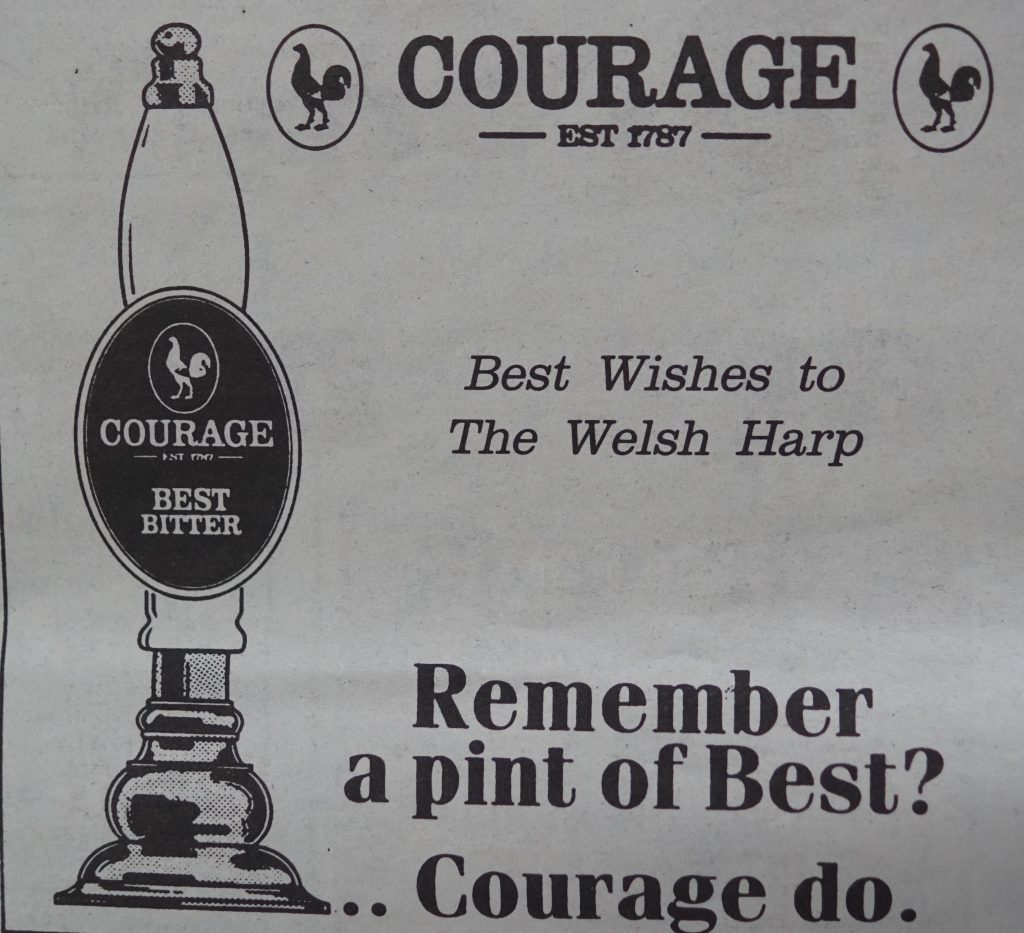
A Courage tenancy, The Welsh Harp begins its new life at 7pm on Thursday July 20th. The first pint will be pulled by the Mayor of Gloucester, Councillor Eric Ede, accompanied by Doug Norfolk, Courage’s senior tenanted sales director for the South West. On the evening of Friday July 21st, there will be live music with the popular duo ‘Perfect Cure’, and also on the following Thursdays featuring ‘Heaven Knows’, ‘Masquerade’, and Hi-Tek’ respectively.
Renowned for the impressive range of lagers on offer – Fosters, Hofmeister, MillerLite and Kronenbourg – The Welsh Harp now offers a fifth, a particularly refreshing draught low-alcohol lager, brand new to this region, called Carlton. The pub is also expanding its range of beers with an especially tasty-thirst quencher, John Smith’s Yorkshire Bitter. Real ale drinkers haven’t been forgotten either. They have a choice between the award-winning Directors and Courage Best. All this, of course, on top of the marvellous selection of wines, spirits, low-alcohol; and soft drinks which The Welsh Harp offers its customers.
Any pub worth its salt these days has to think about food, and here the Welsh Harp is on to a winner! Jill is also looking after the catering side, working from the ‘Queen’s Kitchen’, and, under her direction, the mouth-watering selection of home-made bar snacks and meals will be available at lunch times. In addition to this wide-ranging set menu, there will also be ‘specials of the day’ and Jill promises something a little different from the ‘pie and chips’ fare so often encountered in pub food.
Although the old games room has gone, it will still be possible to play pool and pinball in the magnificent new lounge area, which also boasts a very high-quality compact disc system allowing well over 600 selections.
The Welsh Harp’s impressive extension has been made possible by an input of £50,000 from the brewers, and a lot of hard work, much of it manual, on the part of Barry Hurley, managing director of Places Trading Ltd, and Alan Dee, director in charge of development, Places Trading Ltd.
Tim, Jill and James look forward to offering a warm welcome to customers old and new.
The Welsh Harp 1997
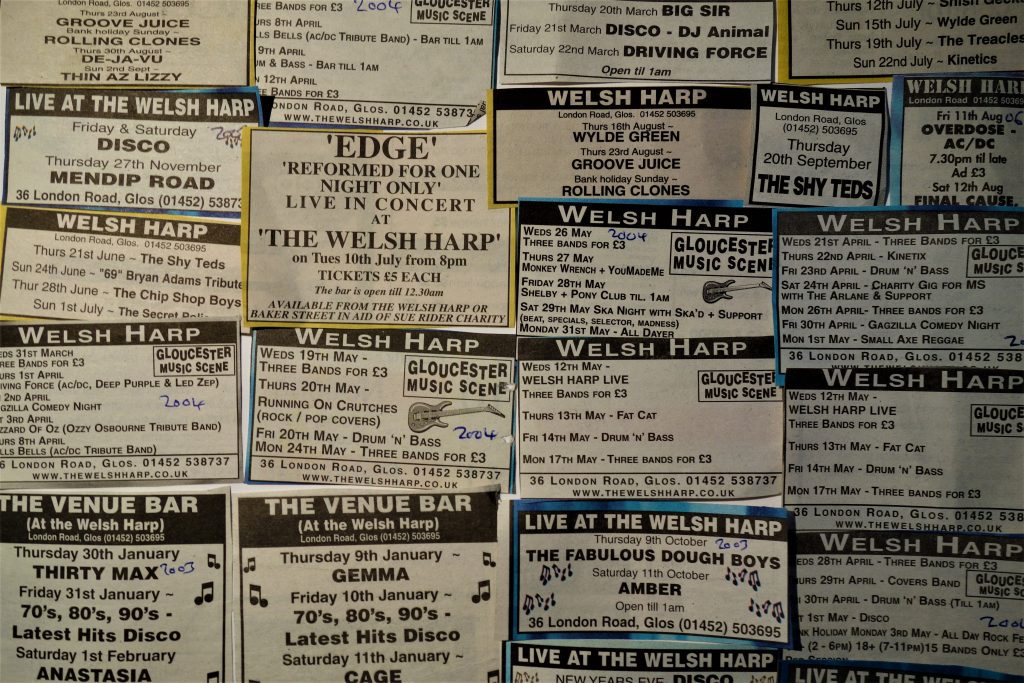
The Welsh Harp evolved into a popular music venue. Neville Staples (former lead singer of The Specials), Bad Manners, The Beat and Chas & Dave all performed there in 2005.
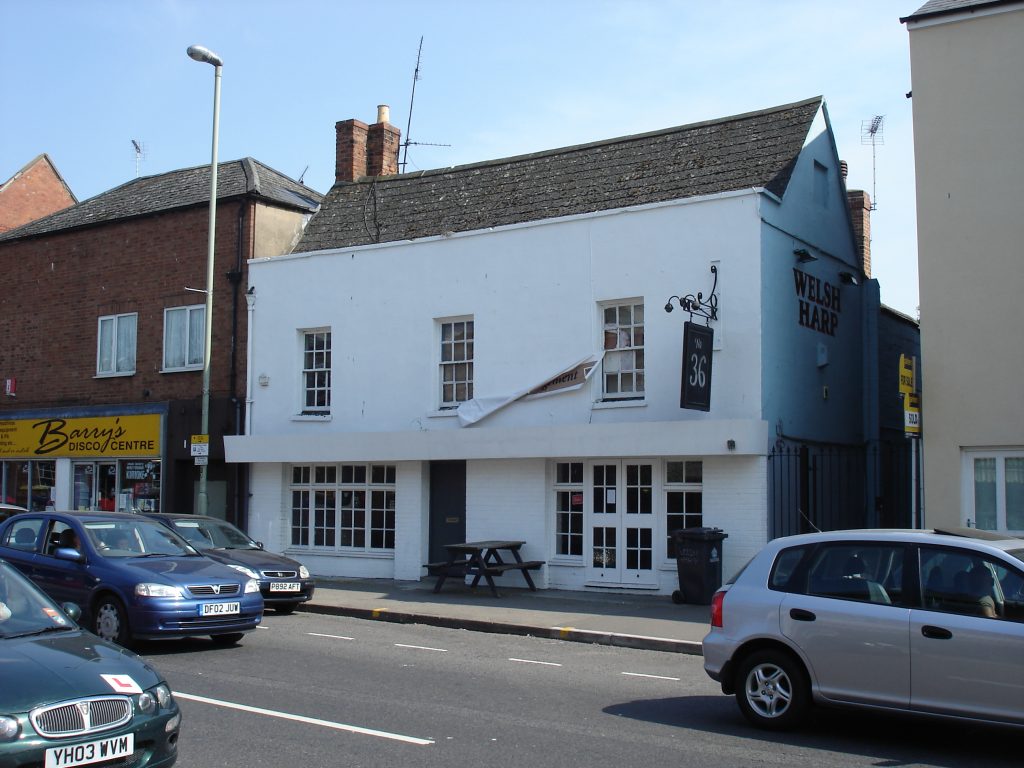
After trading as the Welsh Harp for over 250 years the pub had a change of name in 2007 to ‘No 36’.
The change of identity to 36 did not last long. The building has been converted into a Tesco Express
Landlords at the Welsh Harp include:
1780 Benjamin Mutlow
1818 John Long
1830 Samuel Davis
1839 John Broad
1839 Thomas Gardner (of Longford)
1856,1859 James Tanner
1870 Edward Poole
1870 Henry Randall
1872 William Long
1879 R. Randall
1885 William Ryland
1893 C.J. Burmingham
1902,1906 Charles Thomas Burmingham
1919,1927 Grantley Brain
1936,1957 Godfrey Hy. Moffatt
1950’s Mrs Moffatt
1985 Louise and Paul Lisseman (managers)
1992,1999 – Tim and Jill Shearman
2005 Paul Dewick
2007 Nathan Summer (as no.36)
Gloucestershire Chronicle, 8th April 1838:
William Smith, 20, was indicted for having at Bodington, on the 1st of March, shot at one Ann Farley, with intent to murder, maim or disable. Mr. Skinner conducted the prosecution; the prisoner was not defended by counsel.
The prisoner —I wish to say a word my Lord, I want a shoe- maker on the jury if there is not one.
His lordship – I am sure I have no objection, if there is one on the panel. The panel was looked through, and jurymen were called, but neither answering to their names the trial proceeded.
Ann Farley – I live in the parish of Leigh, about five miles from Cheltenham; I attend the Cheltenham market four days a week and carry back the money for the goods sold. I went to Cheltenham with a donkey cart, on my way home in the afternoon, I called at the house of Mr. Ursell, at Uckington; it was about 6 o’clock; that is about three miles from Cheltenham; I remained about a quarter of an hour; while there I saw a man pass the house; it was the prisoner; that was the first time I saw him; he was going down the road towards Leigh; I afterwards got into my cart and went towards Leigh; when I got near a place called “The Ashes’ I saw Henry Hobbs; this was about two miles from Mr. Ursell’s house; afterward I went on about a mile to where there are some poplar trees; I saw the prisoner on the side of the road on a heap of stones; there is a place along the road called Piff’s Elm, about a half mile beyond the stones and came to my cart, he said “Give me your money or I will blow your brains out,” I was on the cart; I said I had’nt got none; he fired at me; I could not see for some time, for I was covered with blood, which flowed from my hands and face, my baskets were in the cart; when I was able to see again my baskets were in the road; before he fired he get hold of my apron and asked for my money ; after that I did not hear any one, but I suppose he did; he threw all the baskets out of the cart except one, and then he got out and run; Philip Price came up to me then and helped me, and I went on; it was about a quarter past 6 o’clock, and quite light.
By his lordship I had seen the prisoner in Cheltenham before.
By the prisoner—I can’t say how long it was before that I saw him in Cheltenham.
James Ursell—On Wednesday evening, the 1st of March, I saw Ann Farley at my father’s house at Uckington; while she was there, I saw the prisoner go past; he went towards Leigh, I had seen him walking about there that evening — it might be half an hour before, when I saw him go towards Leigh. Ann Farley was at the house, and it was the last time I saw him go by.
Robert Alder— I am a coal merchant living at Cheltenham; on the 1st of March, I was on the road leading from Leigh to Cheltenham; between the Ashes and Piff’s Elm, I met the prisoner ; It was a little after 6; I had known the prisoner before; I said to him “Hulloa Bill Smith where are you going this way ;” he turned round and said “My name is not Bill Smith” I said “I know it is;” I have known him 12 or 14 years since we were little ones together; we have worked together carrying out coal; I afterwards met Ann Farley; it was about 200 yards further on she was following on.
Henry Hobbs also swore he had seen the prisoner as above described.
Philip Price—On Wednesday evening the 1st of March I was walking on the road from Piff’s Elm: as l approached Piff’s Elm, I heard the sound of a pistol; I hurried on in the direction from which the sound proceeded; I saw Ann Farley with her hands and her face bleeding; I did not see any man there; I took her to Piff’s Elmhouse; I know a horse way leading to Arkel’s, at Boddington; Ann Farley was about 20 or 30 yards off; she was past the gate when I met her.
Cross-examined—A stone would not have made the same whiz by me.
By his lordship—It was about two minutes from my hearing the shot to my getting up to her.
William Hanbidge—I am the superintendent of police at Cheltenham; I received information of what had happened to Ann Farley; about 9 on the evening of the 2nd of March, I was in the High Street and saw the prisoner walking before me; I took hold of him by the back of his neck; he had his hands in his trowsers pockets; I put my hands to those pockets and felt a pistol. John Greenall came up at that time; we took him to the station house; on the road he told me several times if I did not let him go I would rue it; he worked his hands on the pistols; this happened several times; when we got to the station I heId him, while the other men forced the pistols from him; I produce the pistols; they are detonators and had caps on; one had a bullet in it; and the other two swan-drops: I produce the loading, I produce the pistol key and bullet mould taken from his pockets; there was a heavy charge of powder in the pistols; I took the prisoner’s shoes from him and went to Mr Arkles’s gate. I observed footmarks commencing about two feet inside the gate; the ground was softer than the turnpike road; the footmarks went along the road towards Mr Arkle’s house; I made marks with the shoes by the side of the tracks; they correspond; both the pistols appeared to have been fired recently– but especially the one loaded with the bullet; when I got him at the Station-house, I told him I had arrested him for firing at and attempting to rob an old woman on the Tewkesbury-road, between Uckington and Piff’s Elm on the previous night he said he had been nowhere on the road neither near Uckington nor Piffs’ Elm; he was billeted at the Welsh Harp at Gloucester.—The Sergeant gave him a billet; I told him I was not aware deserters were entitled to a billet, he said he was no deserter he expected his discharge down in a day or two; he was dressed as he is now.
Cross-examined—Those sprigs made an impression on the dirt; there was no rain on the night of March 1st, or on March the 2nd; there was no rain on Friday morning; the prisoner said “Let me go quietly, and I’ll go quietly”
The prisoner began addressing the jury, and suggested the improbability of the marks of sprigs remaining after rain.
Superintendent Hanbidge said he found some of the marks covered up; they were showed to him by Sergeant Fowler who was in court.
The prisoner said his boots were made in a Northampton manufactory, where hundreds were made together.
Ann Farley was recalled—She said she could see to sew without spectacles. She identified the colour of the coat of a gentleman in the jury box.
The prisoner, addressing the jury, said it was impossible she could have identified him at 19 yards off ; she had been tutored by the policeman at Cheltenham to swear to him, and it was the general practice for the policemen at Cheltenham to tutor people; about four years ago the Superintendent brought him up and told him he was to swear to a man but said he could not; it was a general practice for the policemen to bring people and train them to swear.
The prisoner called Ursell and Price back and cross-examined them.
Price said – I heard the bullet whiz by me just before I heard the report of the pistol
The prisoner concluded his address to the jury by suggesting to them that Price or some comrade of his had committed the robbery.
The prisoner called as witnesses Sergt. Charles of the 64th, and the Sergeant of the 63rd regiment, but neither of them was in Gloucester.
His lordship summed up the case to the jury, leaving it to them to say whether the identity of the prisoner was established, and if so with what intention he fired the pistol.
The jury found the prisoner guilty of shooting with intent to kill and murder.
Mr. Skynner said there were two other charges of highway robbery against the prisoner, but upon these he did not feel disposed to offer any evidence.
His lordship sentenced him to be transported for 20 years:
The above research and information submitted by Dr Martyn Beaufort.