The Royalist has been confirmed by the Guinness Book of Records as the oldest inn in Britain, dating back to AD947. It is a grade II listed building. Evidence suggests that the Royalist began life as part of a Saxon community as far back as AD 514. In AD 949 the Saxon Duke Aethelmar founded the Royalist as a hospice.
The Royalist became the Eagle and Child in the 13th, 14th and 15th centuries. The last battle of the English Civil War took place at Stow on the Wold in 1646. Legend has it that the Royalists were ‘mercilessly butchered where they lay’ in Digbeth Street – some 200 soldiers died in the street. However, it does not seem to have been a licensed property throughout its history and there are no records of it in the 1891 and 1903 petty sessional divisional records.
The Royalist Hotel, with the adjoining Eagle and Child gastro-pub, was acquired by Henley-on-Thames based pub company Brakspear in July 2012.

The Royalist Hotel by Mary Beard 1975 (updated 1997). From ‘Stow-on-the-Wold, Glimpses of the Past’ (Stow-on-the-Wold and District Civic Society in celebration of the year 2000.
There is a long-held tradition that part of this building was once a Hospice built by order of Aethemar, Duke of Cornwall in 987 A.D. on land belonging to Evesham Abbey. During alterations in the early 1970’s, some timber was carbon-dated to 50 years either side of 1000 A.D., which would seem to confirm the tradition. Jack James, joiner and carpenter, who worked on these alterations, describes “the rear wall of the building was a timbered framed together with oak timbers of approximately 9 inches by 5 inches, spaced about 12 inches apart, and a groove chopped in the centre of each timber. Oak split laths would then be dropped into the grooves, and plastered on both sides. This is now an inside wall.” Since the Evesham Abbey records were lost at the Dissolution of the Abbey in 1537, we have no certain knowledge of the use it was put, which might have altered several times in 550 years.
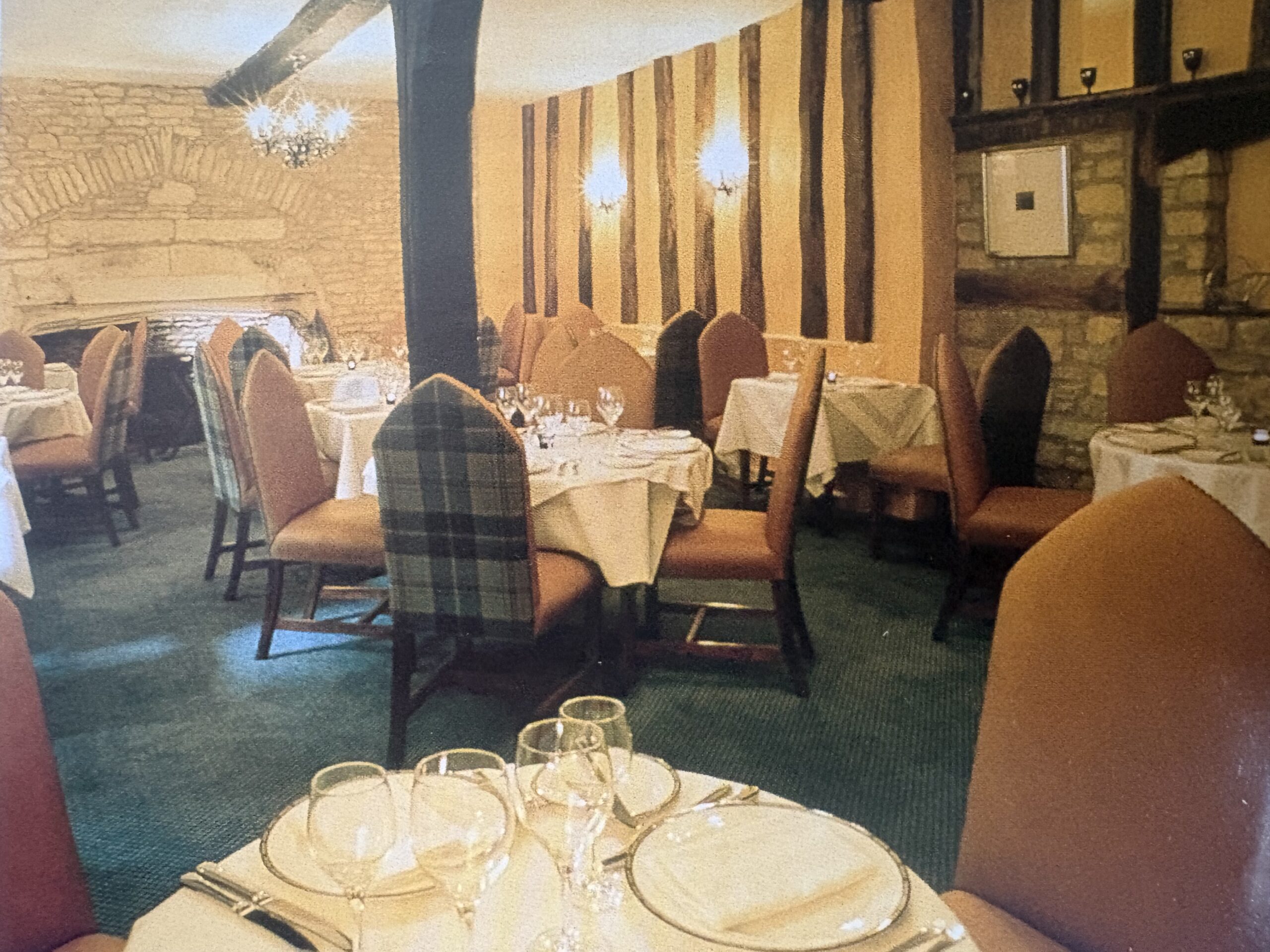
During the later part of the 16th Century a stone house was built on the site incorporating the original Saxon timber building. Jack James describes the roof space above the ceiling as a “beautiful timbered roof with roof trusses and purlins with moulded edges and shaped wind braces.” In what is now the dining room there is a very fine 16th Century fireplace with incised symbols at the side which are said to be protection witches. In 1976 Mrs Winnie Sadler, who had lived in the house in her youth , told of a muddy shoe discovered hidden in a cupboard over an old fireplace. It was long and narrow, with a square toe, a style in use around 1600, at which period shoes were often put in chimneys to ward off evil spirits.
A long room upstairs had a frieze along the outside wall of winged horses with the head and torso of a woman, similar to one in Chastleton House which was built at the beginning of the 17th Century. The piece removed when it was divided into two rooms has been preserved.
There are extensive cellars left when the stone was quarried to build the house. During the occupation by the Army in the 1939-45 war, an entry was found in the present bar with steps down to a cellar, and to a passage leading in the direction of Maugersbury. A number of other such passages have been found in Stow leading to nowhere, and it is possible that they were used for storage.
Recent research by Ruth Stratton has identified the owners of this Tudor House as the Shellard (or possibly Shayler) family. Richard Shellard died in 1586. His widow remarried and became Elizabeth Brookes. In her Will dated 3rd December 1608, she bequeathed her property in Stow to her second son, Thomas Shellard, and then it passed to his only son. Thomas Shellard II. It was he who completed the building with the porch on which he placed his initials T.S. and the date, 1615. It was in this year his elder son John was born. John disappeared on 13th November 1630 when he was 15 years old. In June 1639 an inquisition was made into his disappearance, but no light was thrown on the mystery. It was only in 1681 that his will was proven and his younger brother Thomas Shellard III could claim the property.
The house was disused by 1712, when a suggestion was made to turn it into a Workhouse or House of Correction, but nothing came of it.
The house later became an inn, the Eagle and Child. Under the modern kitchen, a fairly recent extension, and outside the medieval building, Jack James records that “there was a space some three feet deep and about twelve feet square with a fireplace in one corner with a stone hearth and a flue.” It has been suggested that this might have been a cockpit belonging to the inn, since cockfighting was popular during the 18th and early 19th centuries.
About the middle of the 19th Century the building was turned ino two houses, Porch House and Holmlea. The stone canopy over the window towards the west shows the doorway to Holmlea. The fireplace in the western wall was incongruously modern. When it was removed in the mid 1990’s, a series of five fireplaces were found showing various modernisations going back to the early 18th Century and finally revealing another 16th Century fireplace.
The conversion to a hotel dates from 1970.
Birmingham Daily Post – Monday 7th October 1974 – By direction of Mortgagees. Freehold only sale, with early vacant possession. The Royalist Hotel, Stow-on-the-Wold. Having an important position close to the centre of this renowned old Cotswold Market Town: A fine, imposing and interesting period property (repueted c.947 AD) boasting a wealth of original features. 16 bedrooms, all with basins, 8 with own shower units. 5 Bathrooms (two en-suite). Fine dining room, Cocktail Bar, Kitchen, Sitting Room, Private Car Park for 12 cars. All Main Services. Full Gas-fired Central Heating, Automatic Fire Alarm System, Full Table Licence. Great potential for additional restaurant service. Auction (unless sold privately meanwhile) on 14th November 1974. Contact Tayler & Fletcher, Agents and Auctioneers, Stow-on-the-Wold.
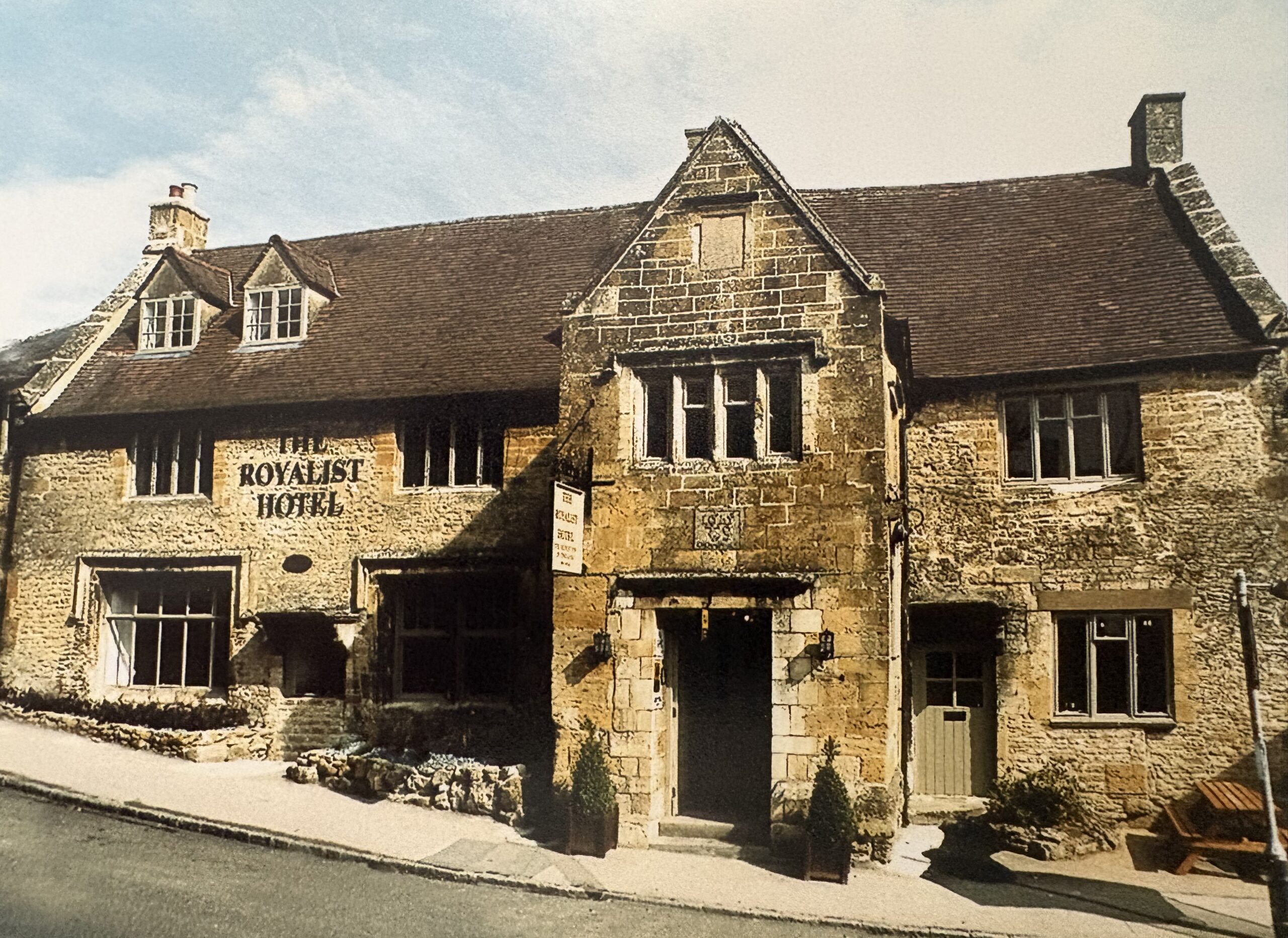
Daily Express, Saturday 5th January 1980 – Advert: The Royalist Hotel, Stow-on-the-Wold offers a two-day special budget stay in the Cotswolds for £13.27 inclusive per person.
Wilts and Gloucestershire Standard, 29th August 1998 – Hotel wants to expand: Plans to expand Stow-on-the-Wold’s Royalist Hotel are to be considered by councillors. the Digbeth Street Hotel, one of the oldest buildings in Stow, would have two extensions. They would house two guest bedrooms, a laundry, creperie, patiserrie, cellar, gent’s toilets, stores and a pergola. The application is to be considered at Wednesday’s meeting of the Cotswold District Council’s development strategy sub-committee.
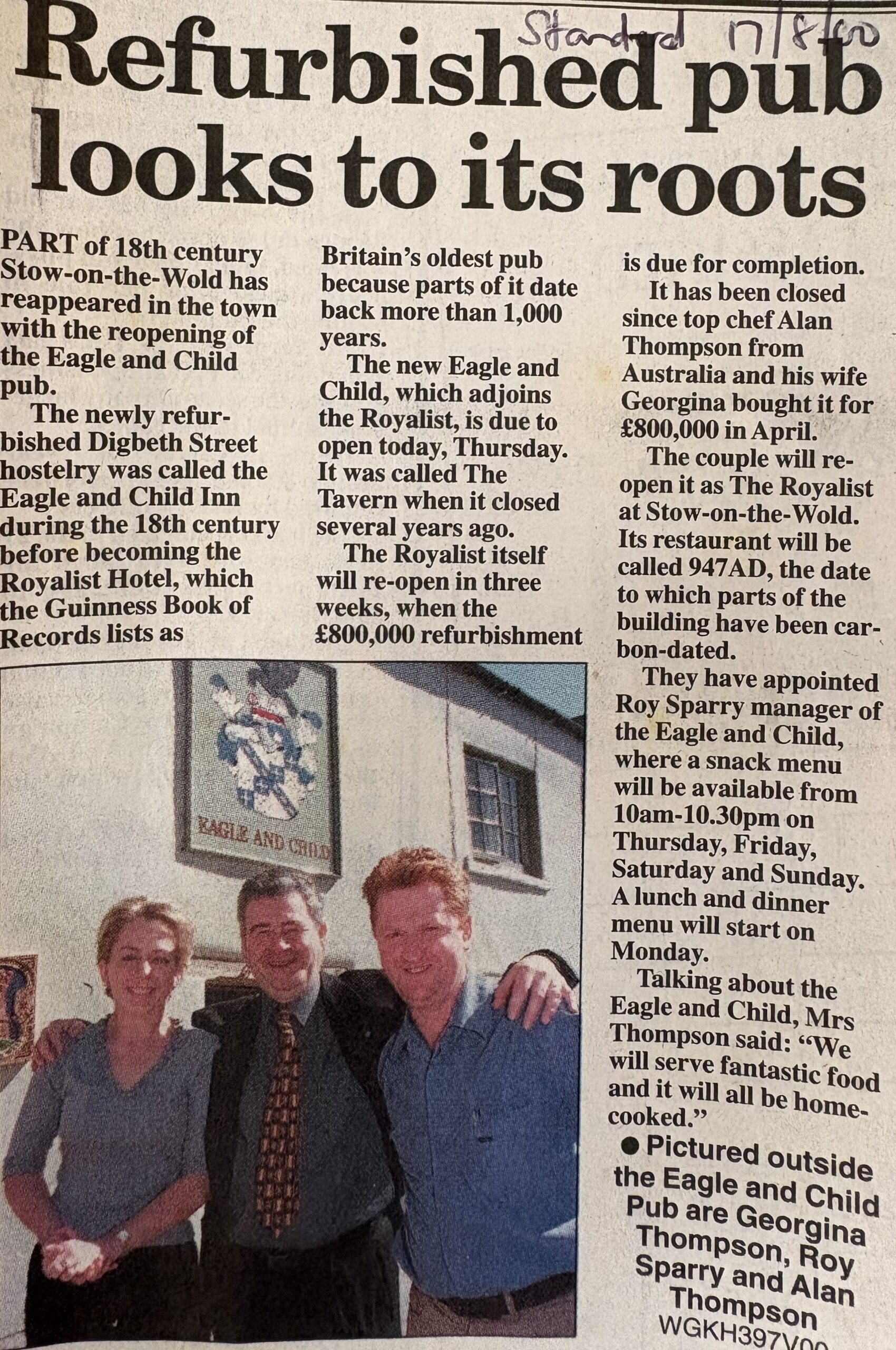
Wilts and Gloucestershire Standard, 22nd September 2000 – New era for UK’s oldest inn: The Royalist Hotel in Stow-on-the-Wold, the UK’s oldest inn, officially reopened last week after an £800,000 refurbishment. New owners Alan and Georgina Thompson have overseen a transformation of the Digbeth Street property, parts of which are 1,000 years old. The couple have renamed the hotel’s restaurant 947AD, the date to which part of the building have been carbon-dated. Last month the pair, who ran a restaurant in London before moving to Stow, opened part of the building as a pub.
The hotel – listed in the Guinness Book of Recotds as Britain’s oldest pub – was sold to them in a £1.6 million deal. They purchased the buildng from the previous owners, Graham and Marie-Frances Clarke, of Blockley. It was closed for three-and-a-half months, for full restoration. The Royalist had planning permission for the alterations for about four years.
They renamed the pub, formerly The Tavern, The Eagle and Child in homage to the building’s illustrious past. It was called the Eagle and Child in the 18th century. The pub’s logo is an eagle protecting a child in a nest.
Commercial Property, 4th November 2003 – Oldest inn up for sale: The oldest inn in England, the Royalist Hotel at Stow-on-the-Wold, has just come on the marker through the Bristol Office of Christie & Co, at a price for the freehold of £1.8 million. This unique Grade II listed building ranks among the top four per cent of protected buildings in the country. It is certified as the oldest inn in England, dating from 947 AD, which was authenticated in The Guinness Book of Records. Evidence suggests that the building was originally part of a Saxon community as long as 514 AD.
The Royalist Hotel is a highly acclaimed hotel and inn which has received a three-star rating and three rosettes from the A.A., a three-star Silver Award from the English Tourism Council and a host of favourable reviews from national newspapers and magazines.
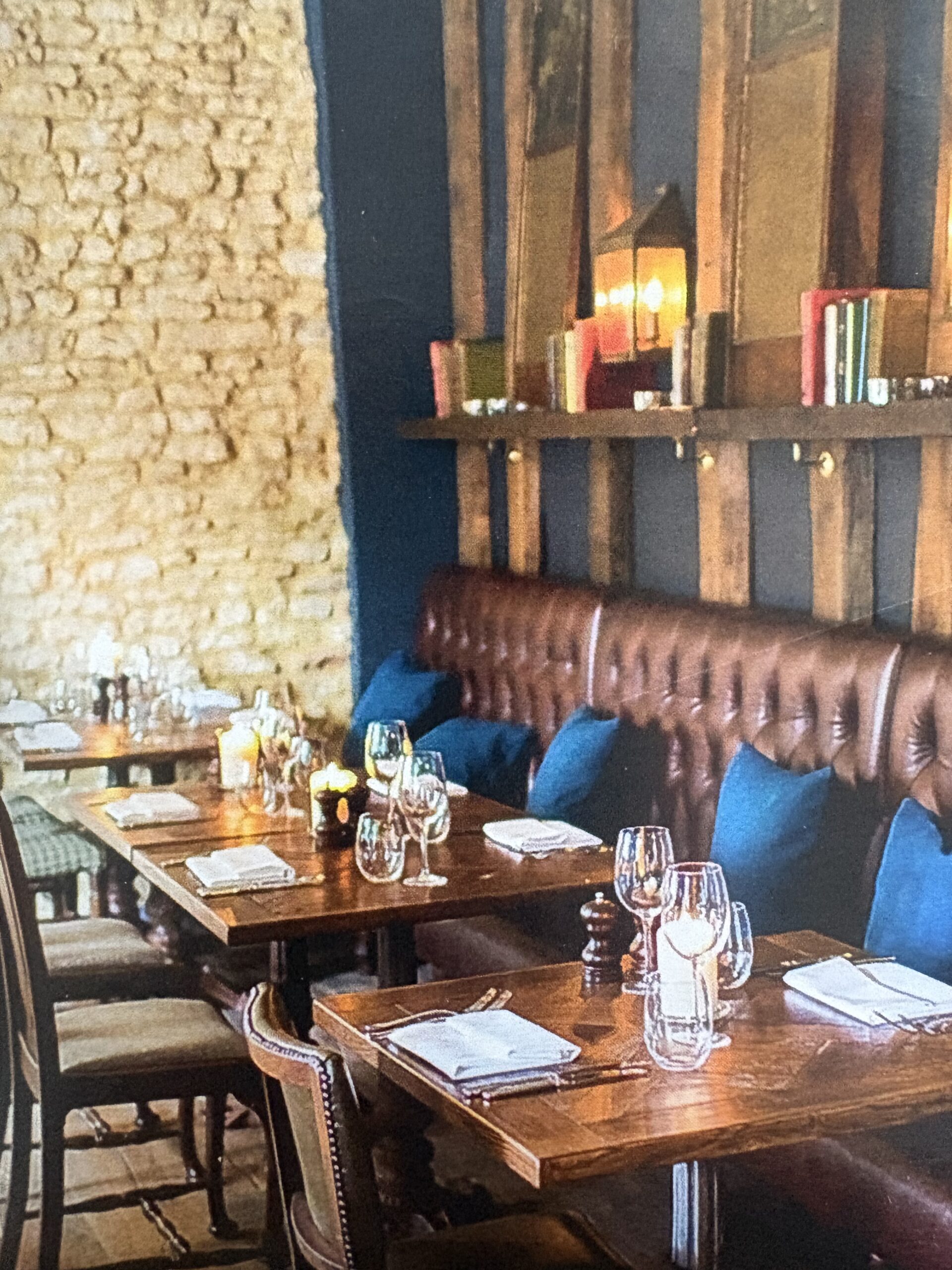
Having acquired the hotel in April 2000, Alan and Georgina Thompson (formerly from 755 Restaurant in Fulham Road London), carried out an extensive renovation and refurbishment programme. They reopened for trade in September 2000 as a 12-bedroom hotel with a restaurant called 947 AD and adjacent food led pub, the Eagle and Child. In June this year the restaurant was completely refurbished and a new contemporary style bar was added. Since then trade has dramatically increased.
Gloucestershire Echo, Saturday 13th March 2004 – Sold for £1.8m: One of the oldest inns in England has been sold for close to £1.85 million. Alan and Georgina Thompson have sold the Royalist Hotel and adjoining Eagle and Child pub in Stow-on-the-Wold to Cheltenham-based restauranter Peter Rowan. The Thompson’s transformed the inn and pub after taking them over in 2000. The Eagle and Child had been closed for around 16 years. The Thompson’s are returning to Australia, where chef Alan was born, in April.
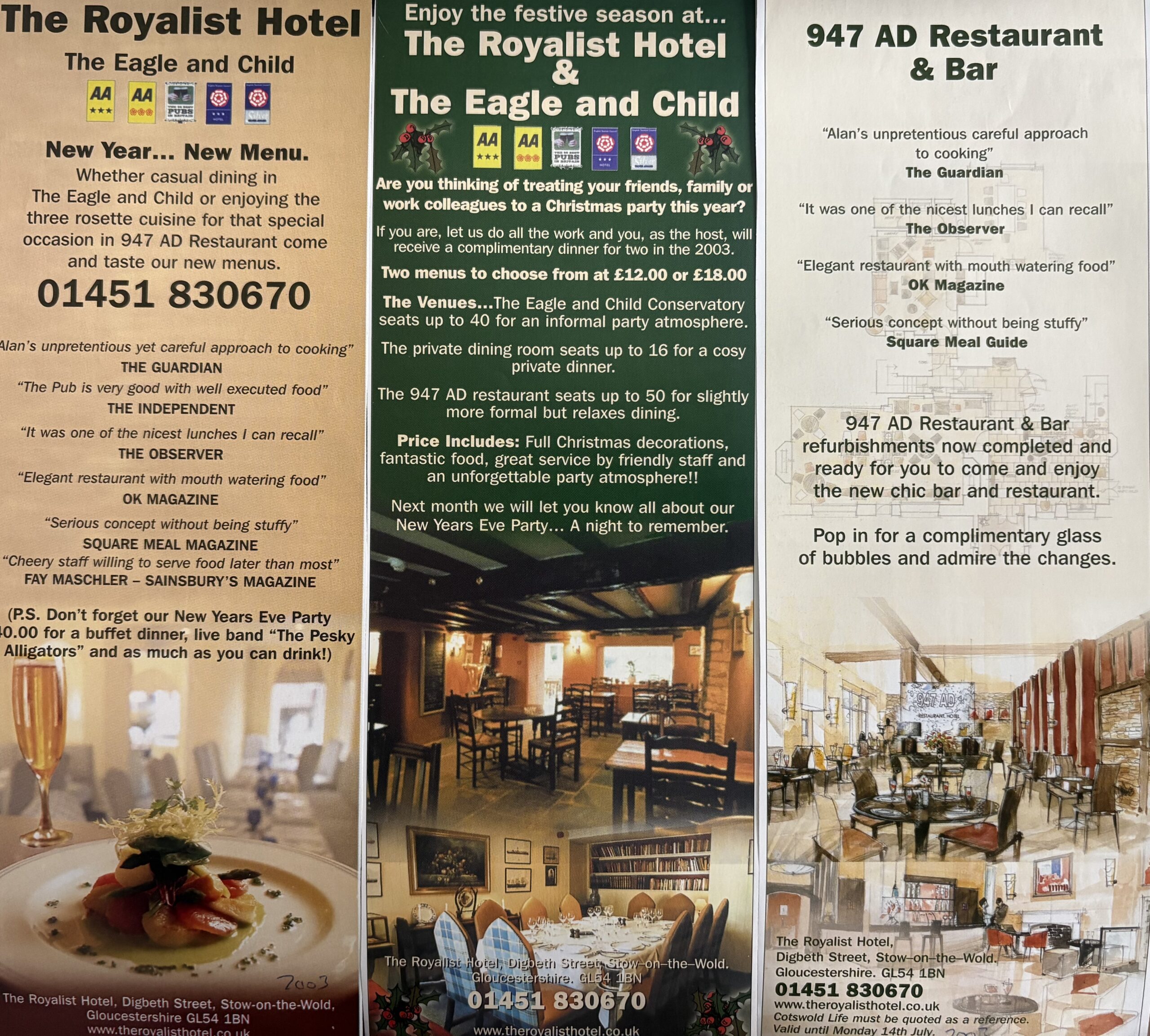
Gloucestershire Echo, 2nd October 2004 – Hotel’s up for sale again: A Cotswold hotel and pub is back on the market after just five months under new ownership. The Royalist Hotel and Eagle and Child pub, in Stow-on-the-Wold, is for sale at £1.85 million. Owner Peter Rowan has not given a reason for selling up but will continue to run his other hotel, the Raleigh’s Cross Inn, in Exmoor National Park, Devon.
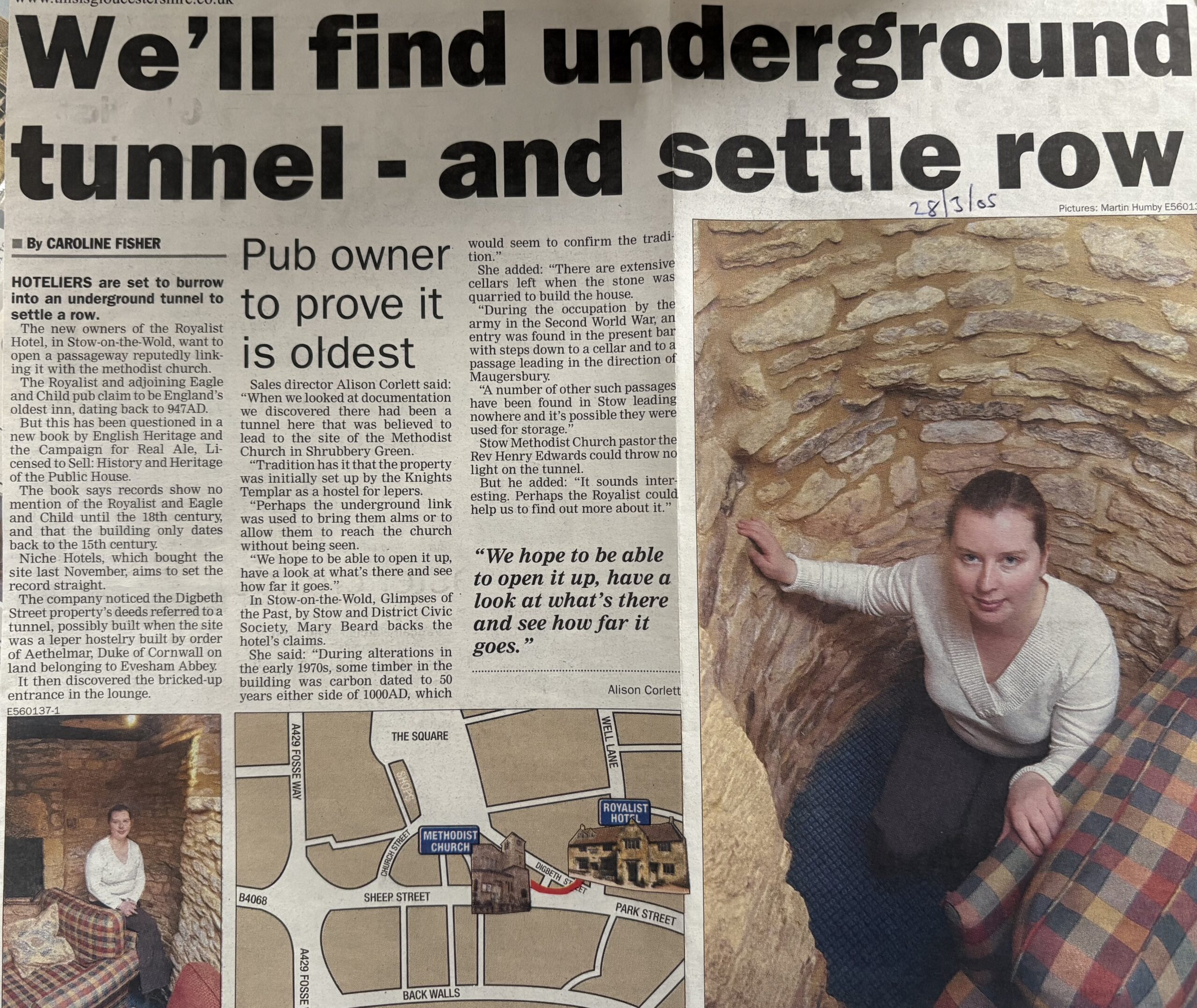
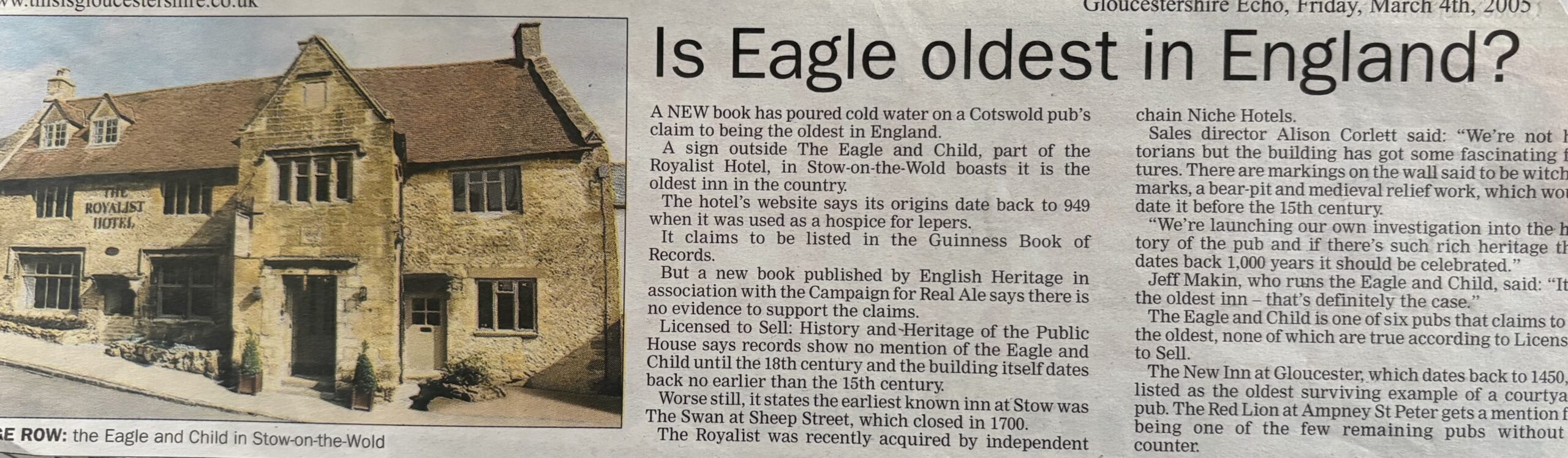
Cotswold Journal, 30th March 2005 – Historians dig deep to solve inn riddle: Hoteliers are set to burrow into an underground tunnel to settle a row. The new owners of the Royalist Hotel, in Stow-on-the-Wold, want to open up a passageway reputedly linking it with a Methodist church. The Royalist and adjoining Eagle and Child pub claim to be England’s oldest inn, dating back to 947 AD. But this has been questioned in a new book by English Heritage and the Campaign for Real Ale, entitled Licensed to Sell: History and Heritage of the Public House.
The book says records show no mention of the Royalist and Eagle and Child until the 18th Century, and that the building only dates back to the 15th Century. Niche Hotels, which bought the site last November, aims to set the record straight.
The company noticed the Digbeth Street property deeds referred to a tunnel, possibly built when the site was a leper hostel built by order of Aethelmar, Duke of Cornwall on land belonging to Evesham Abbey. It then discovered the bricked-up entrance in the lounge.
Sales director Alison Corlett said: “When we looked at documentation we discovered there had been a tunnel here that was believed to lead to the site of the Methodist church in Shrubbery Green. Tradition has it that the property was initially set up by the Knights Templar as a hostel for lepers. Perhaps the underground link was used to bring them alms or to allow them to reach the church without being seen. We hope to be able to open it.”


Gloucestershire Echo, 16th September 2013 – New name and new jobs as historic hotel given revamp: (by Michael Young) Historic hotel The Royalist, believed to the oldest inn in England, has reopened under a new name after a major refurbishment – creating up to 25 new jobs. The Royalist in Stow-on-the-Wold and its adjoining gastro-pub, The Eagle and Child, has opened again under the name The Porch House. The new name is believed to have been in use during medieval times, with parts of the inn’s timber frame dating back to 949AD. The grade-two listed building on Digbeth Street was bought in July last year by Henley-based pub operator and brewer Brakspear. It has invested in a major refurbishment of the place, preserving the inn’s centuries-old heritage while updating parts of the pub. It has 13 en-suite rooms which are now open to the public.
An inscription over the ancient porch reads TS 1615, thought to refer to Thomas Shepam – a benefactor from the area, James Rogers is the new manager at the Porch House, after working at the Old Bell in Hurley, Berkshire – a large, five-star restaurant with a reputation for food. The Porch House has a new menu too, with locally-sourced food and an updated wine list.
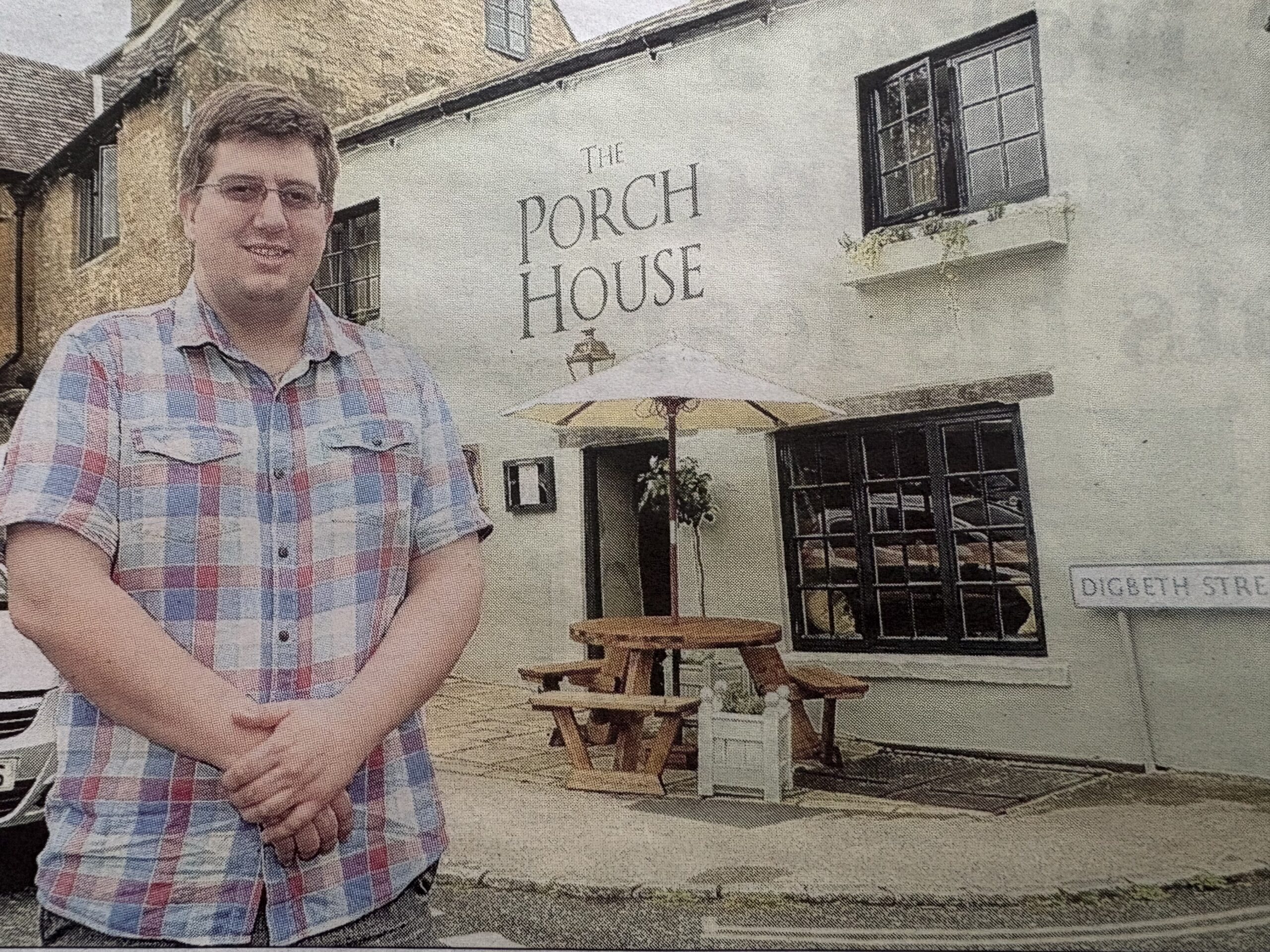
Proprietors:
1990’s Graham Clarke
1992 Matthew Fagg (owner)
2000 Alan and Georgina Thompson