Pubs and Breweries in Gloucestershire Past and Present
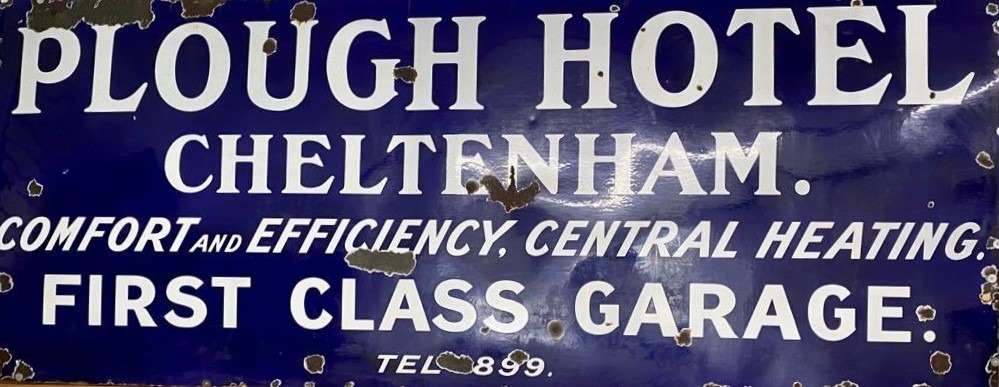
Plough Hotel, (387) High Street, Cheltenham
Gloucester Journal. Saturday April 16th 1870: Billiards. On Monday evening the match for five pounds a side ‘Championship of the County’, was played at the Plough Hotel, between Edward Hodges of that place, and Thomas Thornbury, of Gloucester. Notwithstanding the advantage to the Cheltenham representative in playing on his own table, Thornbury was made the favourite. The game began at twenty minutes past seven by Thornbury given the usual miss in baulk, both playing cautiously, and the scoring was very slow. The only breaks of twenty or upwards were made – Thornbury 21,24,25,20,26,26,32 and 28; and by Hodges 26,20 and 30. When the latter had reached 503, Hodges was at 400 and the game stood at the finish – Thornbury, 1,001. Hodges, 923. There were two intervals.
The Plough Hotel was truly a well-appointed establishment. In the year 1891 the annual rateable value was set at £595.0s.0d. Only the prestigious Queens Hotel in the Promenade was rated at a higher value. The Plough Hotel is recorded as a licensed ale house and being fully owned by the Cheltenham Original Brewery in 1891. The rates had decreased significantly by the time of the next licensing return in 1903 to £510.0s.0d. – a reduction of £85 for which I can offer no explanation unless the Victorian valuation included a parcel of land excluded twelve years later. Another anomaly is that the Original Brewery are listed as lease holders in 1903 rather than outright owners. Jonadab McCarthy is recorded as owner.
Image Courtesy Chris Beer (Facebook Post) Courtesy Geoff Bridgman
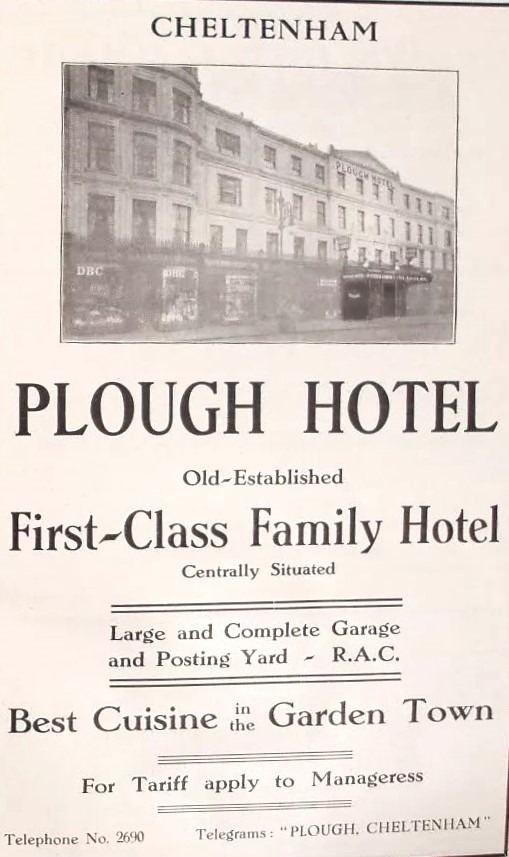
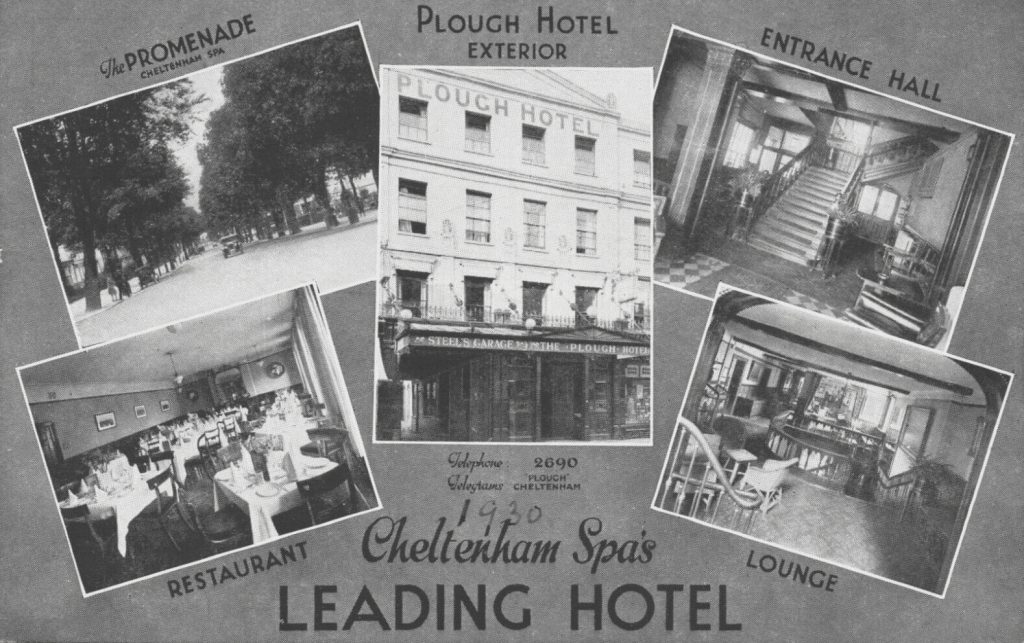
1927 Advertisement.
The Citizen: 18th May, 1982: News in Brief – The multi-million pound Plough site development off Cheltenham High Street, was given the go-ahead by the borough council last night. A special council meeting voted overwhelmingly to back plans for the site itself, extensions to the Everyman Theatre and the building of an overhead walkway linking the development and Cavendish House
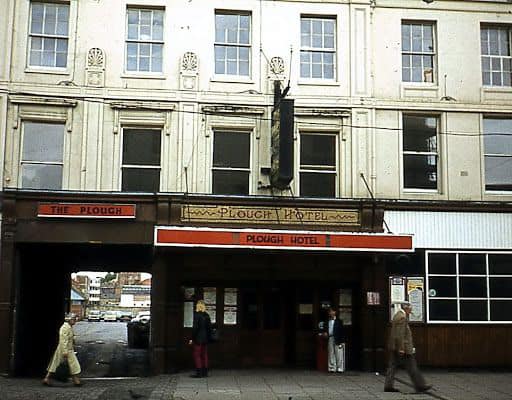
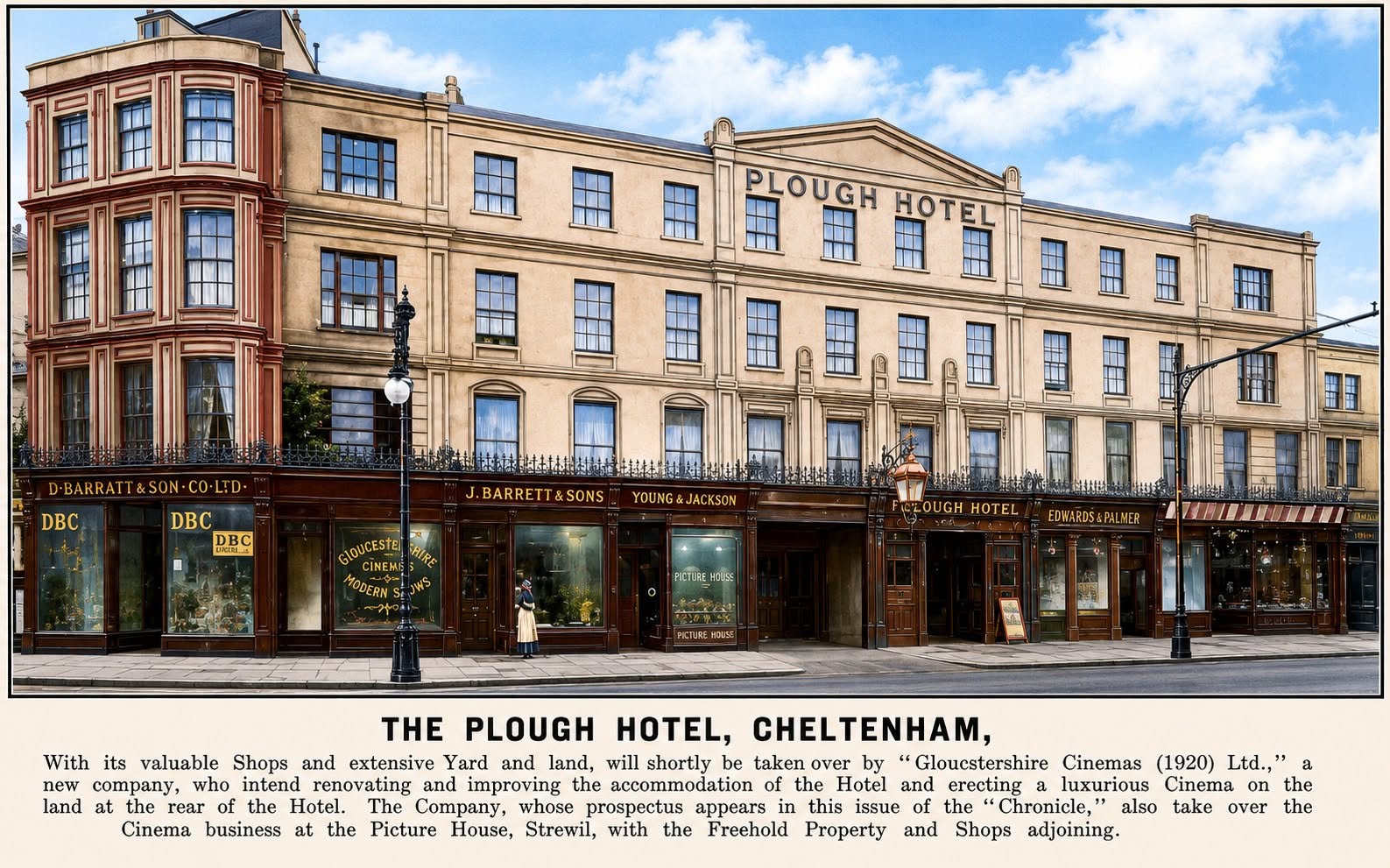
The Plough Hotel was demolished in 1983 and is now the site of the Regent Arcade. The old facade of the Plough Inn has been used as a model for the reconstruction of the arcade entrance.
Hi Geoff,
In respect of the Plough Inn / Hotel which once stood where Regent Arcade is now in Cheltenham High Street, although a limited archaeological dig in 1979 found nothing to substantiate this, there is a belief that it actually dates back to the 16th century. In the Sally Self authored article “‘In the Mault House’:| Four Hundred Years of Malting and Brewing in Cheltenham” (Cheltenham Local History Society journal no. 32, 2016), she writes of records in the Cheltenham Manor Court Books, “The earliest mention of inn keepers comes in 1527…the inns are not named, but one at least is likely to be The Plough.”
When American author and statesman Washington Irving (he of “Sleepy Hollow” and “Rip Van Winkle” fame) stayed there in 1815, he wrote of it, “Not very good.”
It stood across the High Street from the town’s original free-standing market building, which partially obstructed the road like several others in towns hereabouts, such as the rather grand example in Tetbury. On the south side of the High Street opposite the old Corn Market and Butter Cross were located, so the Plough was at the hub of trade and commerce. This is probably why John Wesley, founder of the Methodist movement chose the Corn Market to preach on one of his visits to the town…though it probably didn’t help that they locked him out of St. Mary’s (the Minster)!
Before King George III’s visit to take the spa waters for his health in 1788 made the town de rigeur for the titled, wealthy, fashionable. Cheltenham was rather…”agricultural!” Entertainments then included things like cock fighting, bull baiting and cudgel fighting. These often took place at or near the Plough. I saw a promotional piece for one cudgel fight, which read: “He that breaks the most heads in three bouts, and comes off clear, to receive a good hat and a guinea in money; the second best player half a guinea; and any person whose head is broken, one shilling” !!!
It was at the Plough in 1795 that the first Cheltenham Troop of Gloucestershire Gentlemen and Yeomanry was formed – a volunteer regiment created in response to a national call, as there was then fear of a Napoleonic invasion.
In WWII, it was at the Regent Garage where Frank Whittle assembled the Allies’ first jet engine for the Gloster E28/39 prototype, which went on to become the Gloster Meteor. It is in honour of this that the Whittle Taps on the site of the former Slug & Lettuce was named.
At one point the Plough boasted 54 rooms, 2 billiard rooms, a bowling green and one bathroom!
Right next door at 388 High Street, what had been the Imperial Coffee Tavern 1879 – 1894, became the Imperial Temperance Hotel in 1895, which lasted until 1937. Cheltenham had lots of Temperance Hotels and bars – it didn’t mean they didn’t sell alcohol, just not strong liquor – most still sold ale.
Landlords of the Imperial Temperance Hotel were:
1902 – 1912 JW Curl
1913 – 1916 Mssrs. Curl & Snelgrove
1922 / 1926 G. Stannard (in 1922 listed as Imperial Hotel and in 1926 Imperial Commercial Hotel)
1927 – 1930 Mrs. Alice Lisle (in 1929 listed as Imperial Hotel & Grill Room and in 1930 as Imperial Commercial Hotel again)
1931 – 1934 Theo Rothe
1935 – 1936 Geo. Stannard (possibly the same as G. Stannard 1922 – 1926)
1937 Mrs. LA Roussell
It wasn’t listed in 1938
Also right next door to the Plough but at 386 (and sometimes listed together with the Plough in some directories) was Cheltenham Original Brewery Wine Offices.
I first found them listed as “J.T. Agg-Gardner Esq. MP, Wine Merchant and Brandy Shipper” in the 1872-3 Royal Directory. Same in 1878.
Then in the 1890-1 Post Office Directory as “Mr. J.T. Agg-Gardner Wine Merchant & Brandy Shipper” (Same in 1883-4).
Then in the 1891 Post Office Directory as “Cheltenham Original Brewery Co. Ltd., Wine Offices.”
This is how it remained in listings until the 1929 Kelly’s Directory.
Regards
Alan Jones
Landlords / Proprietors at the Plough Hotel include:
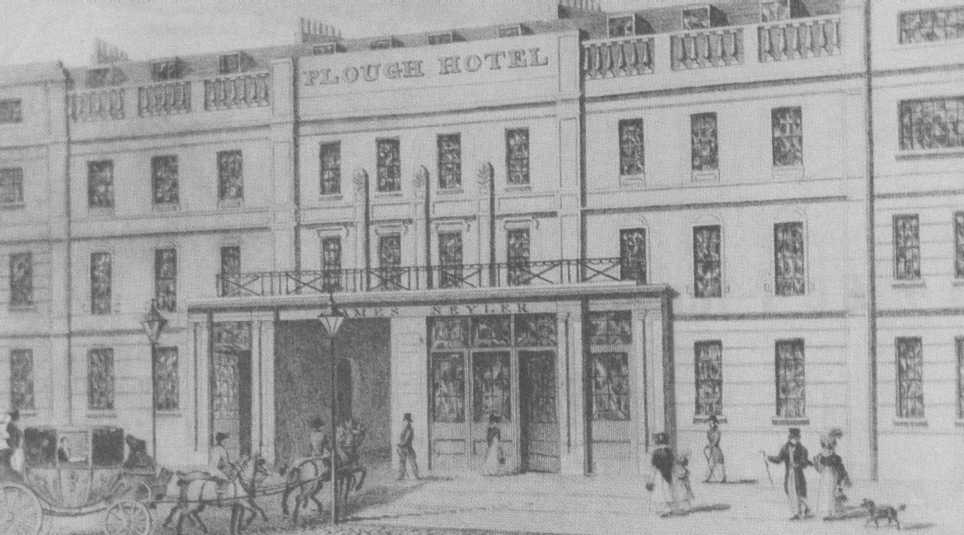
1830 James Neyler
1844, 1859 John Benjamin Churchill
1870 Joseph Rolls (manager)
1878 Plough Hotel Company; H.J. Cochrane (secretary)
1883 Plough Hotel Company
1903,1906 Walter Chapple
1919 Miss H. Powell
Landlords of the Plough Hotel Tap:
1870 Joseph Rolls
1878 William Hill
1883 J. Gibbs
Hi Geoff,
The Spotted Horse was the Plough Hotel Tap House, listed in the 1844 Harper’s Directory as The Spotted Horse with Charles Hughes as landlord.
What is now the side entrance to the Regent Arcade, used to be the entrance from Regent Street to the Plough Inn / Hotel courtyard with its stables, blacksmiths etc. And it was near the entrance to the courtyard that the Tap House / Spotted Horse was located, which it is why it is later listed as in Regent Street e.g in the 1872-3 Royal Directory.
I haven’t seen it actually marked as a beerhouse on the maps I have had access to, but on the 1855-7 Old Town Survey map, it does show the Plough Hotel Livery Stables and Mews, and at the northern (High Street) end along the eastern side are coach houses, with stables marked at the southern end – also a forge in the extreme south-east corner, and a weighing machine just in front of and to the west of this. I would have guessed that the Spotted Horse / Tap House would be one side or the other of the entrance to the Courtyard (as this seems to be the case with many of the other hotels too – from the Crown and the Lamb to the Queens Hotel). As it happens, the 1891-2 Post Office Directory seems to confirm this. At the entrance, to the left (north) were two small cottages called Napier Cottages and to the right (south), set back a little Napier House. In the 1891-2 Post Office Directory in-order listing for Regent Street, the Plough Hotel Tap is listed between Napier Cottage and Napier House. E. Rand was listed as the landlord then.
The 1872-3 Royal Directory listing is more difficult to tell from because Napier House and Cottages aren’t included, that one’s listing for Regent Street just runs:
“J. Rolls, Plough Hotel Tap
Plough yard intervenes
Stamford Terrace”
As it is a listing which runs in order from High Street southwards though, I would assume this would put the Spotted Horse / Plogh Hotel Tap on the north side of the entrance to the Stables and Mews.
The Plough Hotel Tap is similarly listed in the 1876 and 1878 Royal Directories and the 1890-1 Post Office Directory.
 Courtesy Geoff Bridgman