The Oakwood Inn was located in Mill Hill at the end of the Oakwood Road. It changed its name from the Mill Tavern in September 1875.
The pub enjoyed panoramic views towards Bream. However, since ‘last orders’ were called for the final time on Saturday 7th March 1970 trees have encroached on the open space and the private residence is now in a secluded wooded glade.
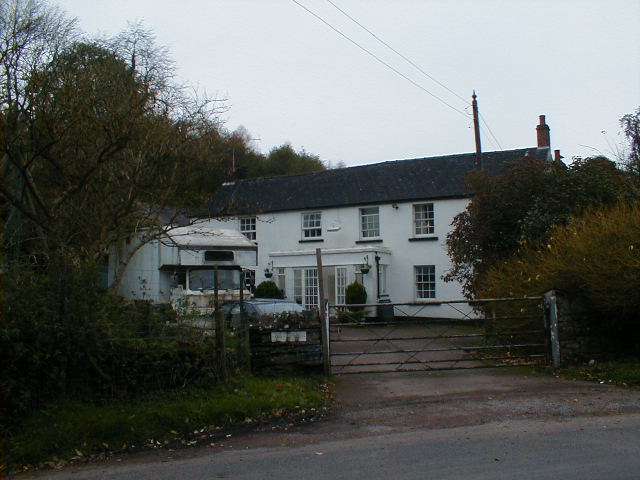
Samuel Musgrove was the owner and occupier of the Oakwood Inn in 1891 when the pub traded free of brewery tie. The annual rateable value of the alehouse was set at £12.0s.0d. Anglo-Bavarian (later Anglo) Brewery in Somerset had acquired the Oakwood Inn by 1903. ‘Supping up’ time was 10 pm. When the Anglo Brewery ceased trading in 1921 the locals quenched their thirsts with Arnold Perrett’s Wickwar Ales. Ownership of the Oakwood Inn then passed to the Cheltenham Original Brewery in 1937.
In Heather Hurley’s book ‘Pubs of the Royal Forest of Dean’ (Logaston Press) an inventory of sale for the Oakwood Inn in 1937 reads:
“All that messuage or Public House known as the Oakwood Inn situate at Bream in the Parish of Newland in the County of Gloucester together with the outbuildings thereto belonging to and the Water Grist Mill called ‘Oakwood Mill’ and all other buildings and appurtenances thereunto belonging together also with the site thereof and the land occupied therewith and also all those pieces of arable and meadow lands and orchard adjoining or near thereto containing three acres or thereabouts comprised in and conveyed by a Conveyance dated the first day of September One thousand nine hundred made between Isaiah Trotter of the first part Samuel Musgrove and Sarah Musgrove of the second part and the Anglo Brewing Company of the third part.”
The stream running through the Oakwood Valley was used to power a corn mill as early as 1520. A foundry had been established on the site by 1852, which manufactured nails for export. It had closed by 1859 but was later worked by the Pearce family and had closed again by c1916. The Oakwood Valley was also rich in deposits of coal and iron ore, of which the latter has been mined since Roman times. The Flour Mill Colliery site is now the home of a Steam Locomotive Restoration and Repair Shop.
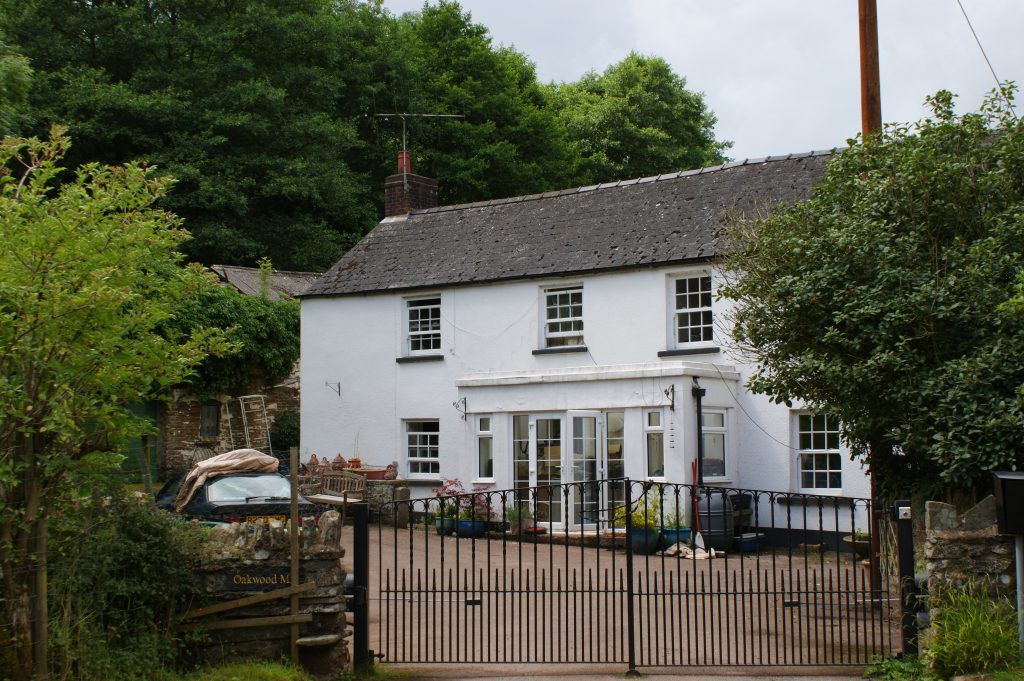
There is a rendered rectangular patch on the wall of the building, which presumably once housed a West Country Ales plaque.
South Wales Daily News, Friday 31st May 1895 – Colliery fatality in the Forest of Dean – a man killed at Bream. Mr W. H. Carter, coroner for West Gloucester, held an inquest at the Oakwood Inn, Bream, near Lydney, on Thursday evening, touching the death of James Allford, 48 years of age, married, who leaves a widow and five children, and who was killed on Wednesday morning whilst at work at the Princess Royal Colliery at Oakwood Mill. The jury found that “The fatality was purely accidental, no one being to blame in the slightest degree.”
South Wales Daily News, Saturday 15th July 1899 – Colliery Winding Accident: Mr Carter, coroner, held an inquest on Thursday at the Oakwood Inn, Bream, touching the death of Thomas Jones Ruck, of that place. 28 years of age, single, who was killed at the New Fancy Colliery on the 12th inst. The following verdict was returned :—” That the deceased died from being smashed by a fall from a cage in which he was ascending in the New Fancy shaft the result of the rope attached to such cage having come off the pulley, under circumstances which to the jurors are unknown.
Gloucestershire Echo, 2nd May 1901 – Coleford. Wednesday – Before Mr. S. J. Elsom. Assaulting a wife: Charles Howard, a collier, of Horrall Hill. Bream, was brought up on a warrant charged with assaulting his wife. Elizabeth Howard, on the 29th April. Prosecutrix said she twice had to fetch her husband from the Oakwood Inn the night question, when he was drunk. While witness was upstairs, her husband caught hold of her the throat, pushed her against the wall, and hurt her arm badly. Her sister then rushed into the house and released her, but defendant continued to use threatening language. She was afraid of her husband, and left the house and went away her mother for protection.—ln answer to Mr. Elsom, Howard said if the warrant was withdrawn he would promise to keep away from public houses in the future and treat his wife properly and provide her a good home. Complainant then withdrew the warrant with this understanding, and defendant was ordered to pay 6s. 6d. expenses.
Monmouthshire Beacon, Friday 21st September 1906 – Refusing to Quit: Harry James, collier, Whitecliff, was summoned by Stephen Bromfield, landlord of the Oakwood Inn, Bream, for refusing to quit his licensed premises when requested to do so on the 8th inst. Defendant pleaded not guilty. The complainant having given evidence as to the disturbance made by defendant, and his refusal to quit after being requested to do so several times, defendant was fined 15s. and 4s, costs.
Gloucester Citizen, 19th February 1930 – Given benefit of doubt – Case Against Bream Licensee Fails: Before the Coleford magistrates yesterday, Harry Cook, licensee of the Inn, Bream, was summoned for supplying intoxicating liquor during non-permitted hours on January 26th and for allowing intoxicating liquor be consumed, Edward Morse, collier, 3, Council Houses, Bream, was summoned for aiding and abetting and for consuming beer licensed premises during non-permitted hours. Mr. C. Prance Drinkwater (Gloucester), defended, and pleaded not guilty. P. C. Bedd’s stated that at p.m. on Sunday, January 26th, he visited the Oakwood Inn, Bream, in company with P.C. Johnson. He saw Cook and Morse and another man in the bar. Mrs. Cook was behind the bar counter. Morse was standing at the counter drinking from a half pint cup. It contained about a teaspoonfull of liquid. Witness smelt it and found it was beer. Morse said it was a lemonade, while Mrs. Cook said it had a dash of beer in it. The licensee said it was bought before time. P.C. Johnson gave corroborative evidence. Mr. Drinkwater submittcd he had no case to answer. There was not an atom of proof that the drink was supplied in non-permitted hours. The defendant having given evidence, the Chairman (Mr. W. A. Bennett) said the case was not quite clear. The police were justified in bringing the case forward but the defendant would be given the benefit of the doubt and the case was dismissed. The summonses against Morse were withdrawn.
Gloucester Saturday 29th March 1930 – Won £2,000 Bream Man’s Luck in Grand National – A Colliery Sweepstake: Mr. Arthur Jones, of Bream, head horseman the Princess Royal Colliery, has won approximately £2,000 in the Grand National having drawn Shatin Goilin in the Coal Trade Benevolent Fund Sweepstake. Mr. Jones, who is between 50 and 60 years of age, was for many years licensee of the Oakwood Inn and the New Inn, Bream. He bought a ticket for 2s. 6d. from Mr. Clifton Morse, clerk at the Colliery, who receives £40 for having sold the winning ticket.
Gloucester Citizen, Tuesday 3rd January 1933 – Forest Woman accused of murder attempt: Women clamoured for admittance at Coleford Police Court to-day, when a Forest of Dean woman was charged with attempting to murder her husband on Christmas night. She was Mrs. Florence Williams, of Woodside, Bream, a small village between Coleford and Lydney. She was arrested in the early hours of Boxing Day, and at special court that day she was remanded in custody.
Mrs. Williams was brought from Cardiff Prison in a private motor-car, accompanied by a wardress. She was smartly dressed in a brown fur-trimmed coat and a close-fitting brown hat. When she arrived at the police station she was given her wedding ring, which she replaced on her finger. Reuben Williams, the husband, appeared in court with his throat and neck heavily bandaged. He was accompanied his two sons.
Mr. F. W. Harvey (Lydney) appeared for the accused, and the Chairman the magistrates was Mr. W.D Deacon. Supt. Shellswell prosecuted for the police. Reuben Williams was the first witness, and was given a seat near the solicitors’ table. There were several women holding babies in shawls, and just as the proceedings began one baby cried. The mother was ordered to take it out of court.
Williams said on Christmas Day he had three pints of cider, a couple of tots of rum and beer. He went home about 3 o’clock the afternoon, and in the evening he asked his wife out to come for a drink. They went Oakwood Mill Inn, and he went into the bar while his wife went into a back room. They stayed there for about two hours, and went home quite friendly. Supt. Shelswell: Did anything happen?— After supper we had few words about something, I don’t know what. Supt. Shelswell: Did you do anything?— I remember going to fall, and pushing her onto the sofa. Supt. Shelswell: What happened then? I found myself down my knees by the fender and blood was running from throat.
Williams, proceeding, said he thought he had fallen from the chair into the fender. Supt. Shelswell : Do you know man named Vaughan —Yes, sir. Supt. Shelswell : Do you know where he was that night – No sir? Supt. Shelswell: Did you accuse your wife of being intimate with this man -No sir. Supt. Shelswell – Did your wife think you had accused her? —Yes, sir.
Cross examined Mr. Harvey, Williams said he was not taken to the hospital after the occurence and had prepared his own food. Mr Harvey: you think your wife | attempted to murder you?—No, sir. If she did she would not have had much trouble. Mr. Harvey: You were drunk? —Yes, sir, cider always gets the better of me. Mr. Harvey: Were you so drunk that you did not know what was happening?—’ Yes, sir. That is in the last hour.
Williams corrected his statement as to the time he was the public house, and said he was there from opening time closing time. Mr. Harvey: Was it farmhouse cider or “stun ’em”? Mr. Harvey: Do you know the difference? – I ought to.
Williams explained in reply to further questions that the landlord of the public house gave about a gallon of rum and beer to the company. He denied that he had accused his wife of misconduct with two men when went home for the Christmas dinner. Mr. Harvey: Did your dinner make you feel better ? -Yes. I expert it did; it did not make feel any worse, anyway.
Williams said he went to sleep after dinner, and later he asked his wife to go out for a drink. He left the public house about 9 o’clock. Mr. Harvey: Was not closing time ? —No. Mr. Harvey: Why was your wife waiting for you the passage? —Because she wanted me to go home. Mr. Harvey: Did you quarrel with her because she refused to go into the bar with you ? – Well, I asked her to go in.
Williams said his son Jimmie was in the room when he went home. His other son Albert came downstairs and flung a tin of carrots at him because he and his wife were acting the fool on the couch. His wife had a knife in her hand when he began to act the fool, but he did not think she had been cutting bread. She still held the knife when she tried to escape through the door. Mr. Did you run after her?—l might have gone to the door, but I did not go outside. Mr. Harvey: When she was trying escape, and waving the knife might you have run against it. and cut yourself ?—Yes, sir, I might have done. Shelswell: Do you know what became of the knife —No, sir. The Clerk (Mr. Herbert Williams): How long was it after you saw the knife in your wife’s hand that you knew you were hurt – About an hour, sir.
Gloucester Citizen, Wednesday 4th December 1946 – Inquest on Forest Miner: A 57-years-old Forest of Dean miner was on the sick list for nine weeks. During that period his heart muscles became flabby. As a result, when he returned to the pit, he collapsed and died at the end of shift. The explanation that absence work had caused his heart muscles to become flabby was given by a doctor the inquest at Bream, on Tuesday, on Sidney James who, in addition to being a miner at Princess Royal Colliery was the licensee of the Oakwood Inn, Bream. The widow told the Coroner (Mr. M. F. Carter) that her husband had not suffered from any serious illness, but had been away from work with septic eczema. Elton George Berrow, a St. Briavels miner, stated that at the end of the shift James and he started out together to walk the two and a half miles to the bottom the shaft. They had a lift for a short distance and then resumed walking. James seemed to twist round and begin to fall, but I managed to catch him and held him until he died in my arms” he added. Dr W.H. Tandy (Parkend) said the cause of death was thrombosis of the coronary artery of the heart. Recording verdict to this effect, the Coroner expressed sympathy to the widow and family.
Dean Forest Mercury – Friday 13th March 1970: Popular old inn will be missed. By Harry Price (DFM Bream Correspondent)
After well over a century of trading the Oakwood Inn, Bream, better known to local residents as “The Mill”, has closed its doors. Mr and Mrs Ivor Ellis (Ivor is a Bream man), drew the last pints on Saturday evening. How many no one knows as there was a crowd of over a hundred at the social evening. There was a tinge of sadness about the affair as this was a quiet, but none the less popular old inn which will be greatly missed by many. It has been a rendezvous for the local commoners (or sheep badgers) and many is the deal that has been discussed and completed in the bar, over a pint.
It was also a port-of-call for some of the hikers from Mitcheldean to St, Briavels and vice-versa in the summer, a the ‘waymarked’ trail leads close to the inn, an on a hot summer day a “shandy” was quickly seen off. This next summer no doubt many will be disappointed to find it closed.
How long ‘The Mill’ has been a public house no one seems to know, but the Death Club (which has now moved to the Rising Sun) was in its 104th year. Subscriptions to this used to be 1/6d. per month and the object was, of course, to see (to use a local term) that everyone was put away tidy when they passed away. We wonder who were the men who had the vision to start this Club, which reached a membership of 250, when state help was unheard of and industrial insurance companies were then virtually unknown.
Undoubtedly the ‘Mill’ derived its name from the time when the local farmers brought their corn to grind to flour by the Mill which was driven by a water wheel. Little of the actual Mill now remain, but the stream that supplied the motive power is still there. So is part of the granary, which at one time used used as a dance hall up till about 50 years ago.
The Oakwood has always been able to run a good darts team, and to complete their fixtures this season they will be accommodated at the Cross Keys, Bream. They compete in the Tidenham League
After the hectic Saturday evening Mr. and Mrs. Ellis faced the massive clearing up process on Sunday, and on Monday morning. I saw Mr. Russell Pegler, a local contractor, removing “The Oakwood Inn” letter by letter; which was part of the improvement effected by Whitbreads only two or three years ago, when several hundreds of pounds were spent on decorating, etc.
Mr. and Mrs. Ellis have been hosts the Oakwood for nine years, moving there when the Royal Oak closed at Yorkley where they were in business for seven years. They are retiring to Ellwood. The premises have been purchased for private occupation by a gentleman from London who informs me that it is his intention to retain them as original as possible. He came down especially for the last day as a “pub” and joined the last of its customers.
Landlords of the Oakwood Inn include:
1876,1891 Samuel Musgrove (listed as miller, Oakwood mills and Oakwood Inn in 1876)
1900 (September) ‘The license of the Oakwood Inn, Bream, was temporarily transferred from Samuel Musgrove to Charles Morse’
1902,1903 Charles W. Morse (listed as builder and undertaker in 1903)
1906 Stephen Bromfield
1907 Arthur Jones
1919 William Pitcher
1927, 1930 Harry Cook
1930’s Charles Truman
1939, 1946 Sidney James (see above)
1961-1970 Ivor and Mrs Ellis (they were at the George at Yorkley previously)