Pubs and Breweries in Gloucestershire Past and Present
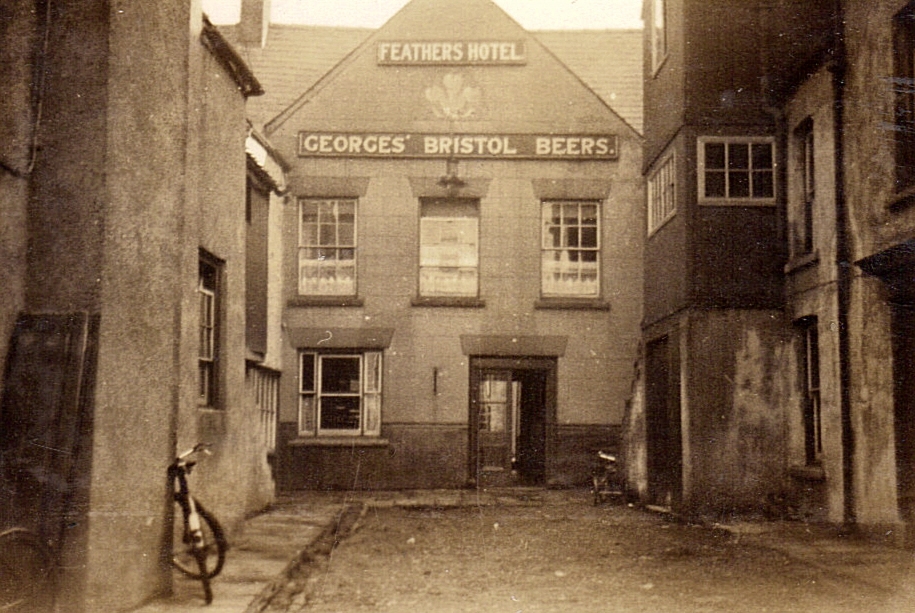
Feathers / Plume of Feathers, Market Place, Coleford
The Plume of Feathers was open in 1654 and possibly even before that. The late Ray Allen wrote in the Forest Review newspaper (Sept.1998) about Coleford pubs and, of the Plume of Feathers Inn, he wrote: ‘It was sold in 1672 by Stirley Kedgwin Snr. to Richard and Mary Sladden, the latter being Kedgwin’s daughter. It was acquired by the Hall family of Highmeadow who rented it in 1769 out at 1s.6d. weekly. Henry Jenkins bought the inn from Lord Gage when he wound up the family’s local estate that century.’
The Feathers Inn was put up for auction on 23rd March 1827. The inn was owned by Henry Jenkins, an innkeeper and stonemason, who had been declared bankrupt in 1819 and had served time in a debtor’s prison. He had no option but to sell his real estate which included the Feathers Inn. The auction was held across the road in the Kings Head. The Feathers was described as ‘a freehold property being the real estate of Henry Jenkins, late of Coleford aforesaid, innkeeper and stone cutter, an insolvent debtor, who was discharged from the King’s Bench Prison, in or about the month of February 1820’. The sale particulars described ‘all that commodious inn and public house, called the Feathers Inn, situate in the centre of the said town of Coleford, together with two large yards, four large stables & other attached buildings, with the appurtenances thereto adjoining, late in the occupation of Mr George Wintle, and now of Mr Richard Smart, as tenant thereof.’
In 1830 it is documented that Thomas Plaisted carriers ran a service from the yard of the Plume of Feathers to Gloucester.
Monmouthshire Beacon, Saturday 4th January 1851 – To Be Let: With possession on the 2nd February 1851, that old-established and very thriving inn, known as THE PLUME OF FEATHERS, situate in the centre of the town of Coleford, and now in the occupation of the proprietor, Mr. Milson Harris.
The house possesses extensive stabling, coach-house, commodius back premises, and every convenience for a good market and general trade; with large club room, commercial, and smoking rooms, bedrooms etc, etc. Apply to Mr Milson Harris, on the premises.
Gloucester Journal, Saturday 19th January 1856 – To be sold at Auction by Mr R. White: At the Plume of Feathers Inn, in the town of Coleford, on Friday the 25th January, 1856, at three o’clock in the afternoon, subject to conditions to be then produced, – All that established, extensive and commodious inn and premises, situate in the centre of the town of Coleford, called or known as “THE PLUME OF FEATHERS”, for many years in the occupation of Mr. Milson Harris, now of Mr. Benjamin Gwilliam, as tenant thereof, at an annual rate of £55.
The premises are freehold, and comprise a very spacious dwelling house, brewhouse, meat shop, slaughter house, large yard, stables, coach houses, piggery, and other conveniences, well adapted for combining the trades of butcher and licensed victualler, as heretofore, and have lately undergone very extensive repairs and improvements. The sum of 500/- part of the purchase money, may remain upon mortgage of the premises, at 5 per cent. The tenant, Mr. Gwilliam, will show the premises; and for further particulars, apply to the auctioneer, or to Mr William Roberts, Junior, Solicitor, both of Coleford.
The Plume of Feathers, an alehouse, had an annual rateable value of £21.12s.0d. in 1891 and 1903. Amos Smith is listed as the owner in 1891 when the inn was operating as a free house, with no restrictions on beer supplies. Yet just 12 years later the Feathers had been leased to the Ashton Gate Brewery in Bristol. It was owned in 1903 by the representatives of Mary Ann Smith.
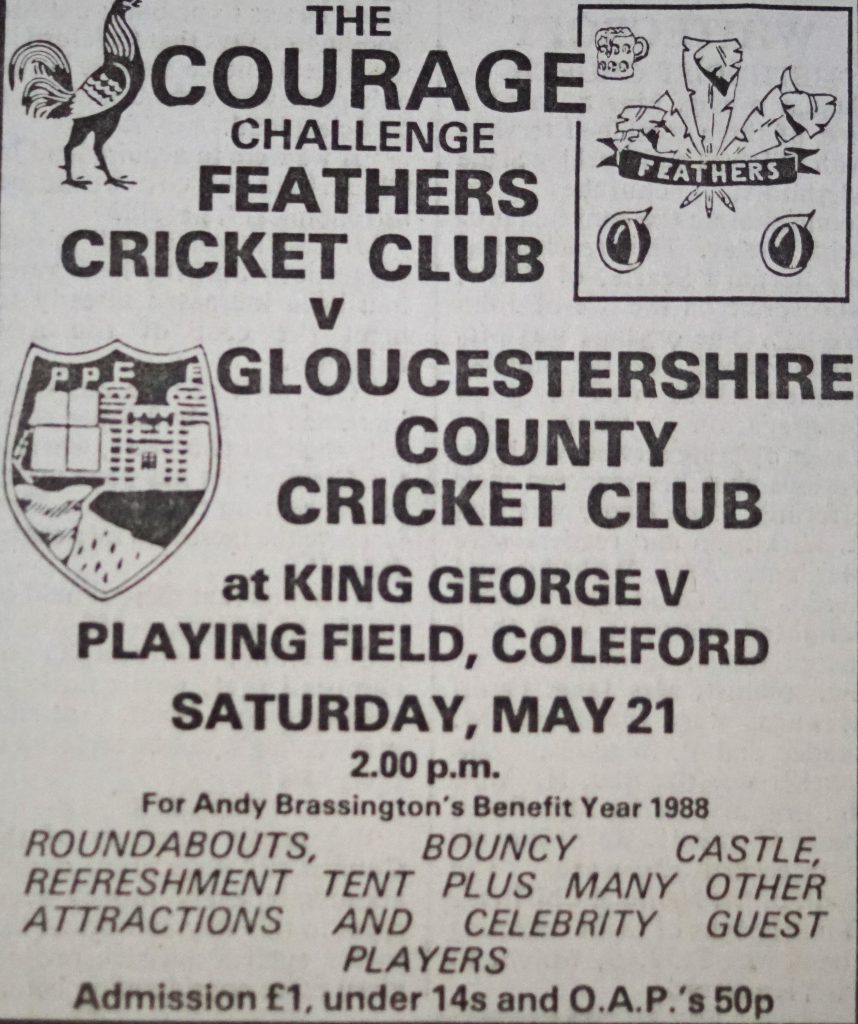
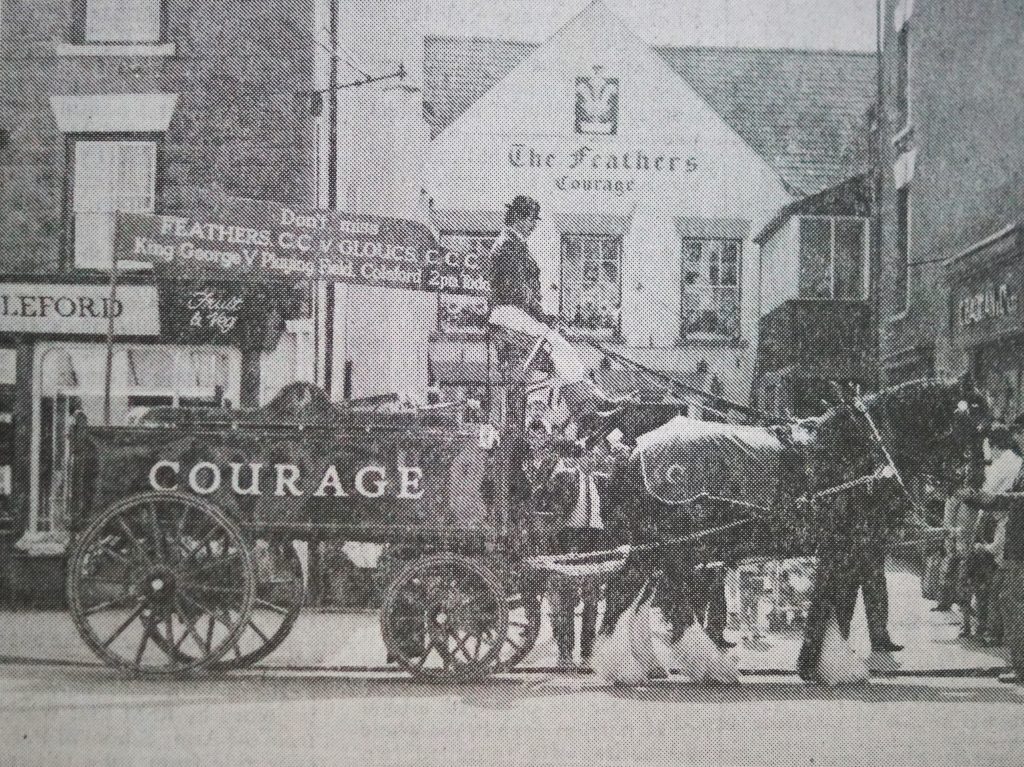
Lydney Observer, Friday 27th May 1988: Runs galore as County pip Feathers at Coleford (edit): The weather was dry and sunny as the two captains walked out to the middle of the pitch at the King George V Memorial Cricket Ground, Coleford, for the toss at Saturday’s match between the Feathers C.C. and a Gloucestershire XI for Andy Brassington’s benefit season. It was the first time a County side had played at Coleford since 1936.
The County side won the toss and opted to bat first on a dry flat wicket. They finished on a score of 308-8 off 40 overs, 39 runs coming off the last four overs. Top scorer was A.J. Wright, 55. After tea Gloucestershire took the field and the Feathers openers, M. Camp and A. Morgan set about the task of scoring 309 to win. Twenty five runs were put on the board before A. Morgan fell l.b.w. to A. Wright for one. M. Camp followed soon, with the score on 26 but not before hittng Syd Lawrence for three boundaries in his 14. T. Kettering was joined at the wicket by Kevin Curran, the Gloucestershire all-rounder who was a “Feather” for the day. What was to follow, no one could have dreamt of. In his stay of just 101 balls in a little over two hours, Kevin scored 205 runs. Of these 172 came in boundaries, no fewer than 16 sixes and 19 fours. In one over, off the unfortunate P. August, Kevin scored 30 – three sixes and three fours; and during his stay at the wicket five balls were lost in the surrounding fields and hedges. The innings was chanceless until he was bowled by I. Hamilton and was surely one of the most entertaining knocks ever seen in the Forest.
Meanwhile the Feathers batsmen did their best to hold up the other end, but one by one they lost their wicket. A Price (12) and T. Ketteringham (11) being the only ones to reach double figures. At the end of their 40 overs, the Feathers had reached 294 with one wicket remaining, so lost the Courage Challenge by a mere 14 runs.
Given the good weather and the quality of the cricket played on that afternoon, it was disappointing to see a crowd on only 500 or so, but those who came enjoyed their day out and went home fully satisfied.
Man of the match was Kevin Curran.
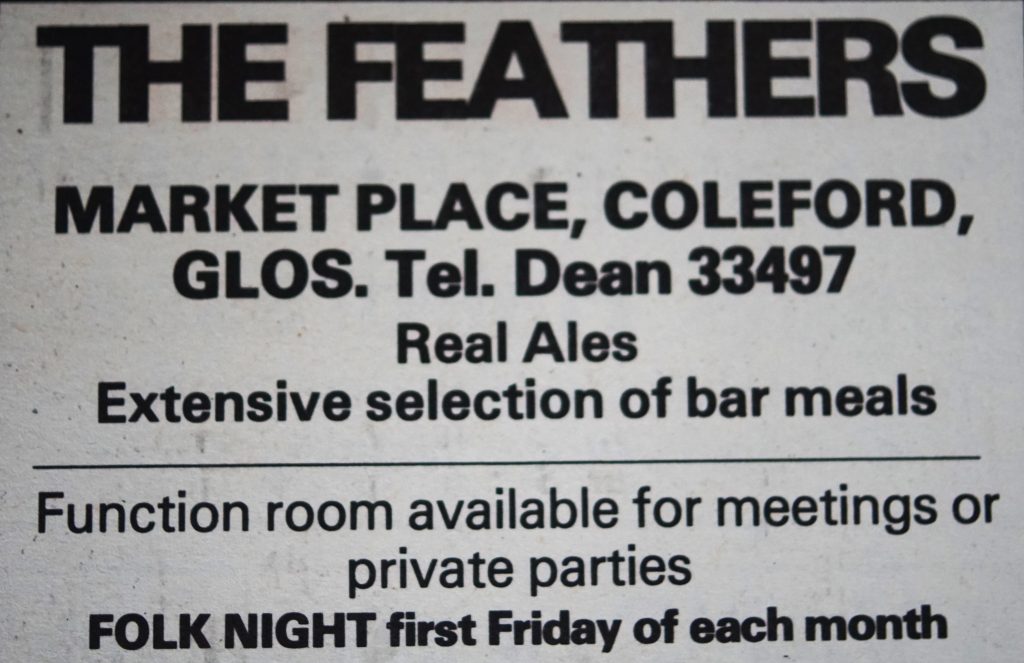
Pubs of the Forest of Dean & Ross-on-Wye. A critical guide by Jon Hurley (booklet, 1991): Buzzing with locals, drifters (like us) and shop girls, the Feathers feels and looks like a pub. Great atmosphere under the landlords robust direction and his staff are efficient and not afraid to exercise their facial muscles. Low, smoky ceiling and horse brassy, the Feathers knows how to serve pleasant food at realistic prices and the Courage’s beer is a welcome invader in Whitbread territory. Upstairs folk music is heard on certain evenings and among the bantering clients was ‘varest’ poet Keith Morgan of “The ‘Azard O’ Chimmuck Szwippin” and “Alberts Dree Wi’ker” fame. Staring into his pint Keith was searching for his muse but hadn’t found it when we left. A little upright piano stood awaiting its Saturday night tickling in a corner.
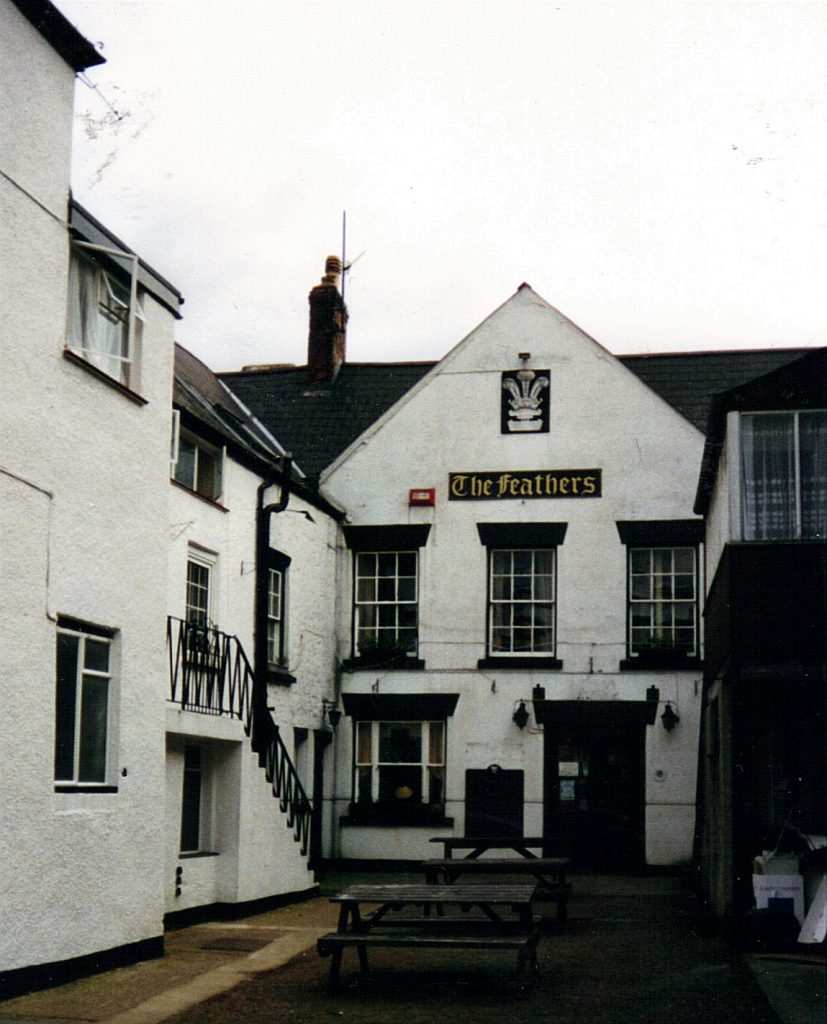
The 1996 edition of ‘RAIG – Real Ale in Gloucestershire’ described the Feathers as a ‘friendly town centre pub. Home cooked food served at lunchtime (not Sunday). By arrangement parties can enjoy a Bierkeller atmosphere with steins of ale. Outdoor seating in the courtyard in summer.’
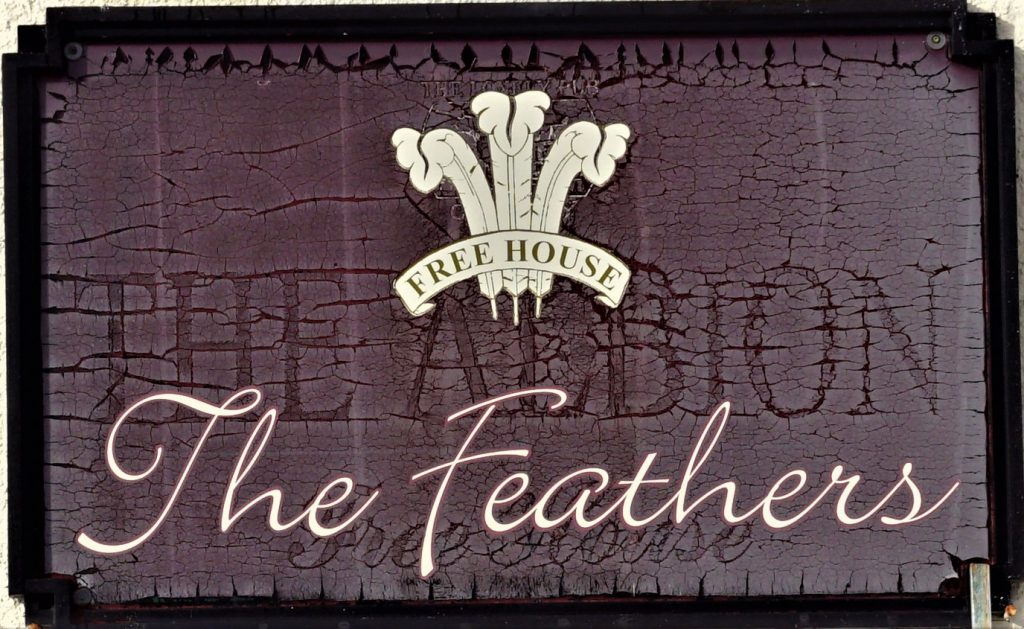
Coleford Transport Festival 2006The rear of the FeathersThe present day signage – a repurposed sign from a pub called the Albion.
The owners of the Feathers in 2007 were Inns 2B Inn Ltd. It is now owned by the Bridlington Pub Company.
Gloucester Journal, 18th August 1851:
THE HIGHWAY ROBBERY AT JOYFORD. NEAR COLEFORD.
The Court assembled this morning at eight o’clock, to try the remaining case in the calendar, the particulars of which appeared in our impression at the time.
Thomas Smith, 23, Richard Smith, 27, and James Brown, 21, were indicted for having, at West Dean, on the 15th of July, violently assaulted Joseph Jones and stolen a metal watch and gold seal and watch key, and 2d in money.
Mr. Skinner and Mr. Cripps appeared for the prosecution; Mr. Huddlestone defended the prisoner Brown; and Mr. Cooke defended the Irishmen, Thomas and Richard Smith. Our readers will remember the particulars of this case which we gave a fortnight since. The prosecutor is a watchmaker, residing at Joyford, in the township of West Dean. On the night of the 14th of July he was at Coleford on business, and called on his way home at the Feathers lnn for his umbrella, Mr. Harris (the landlord) having borrowed it about ten o’clock the same night. He found Thos.Teague and the three prisoners, Thomas Smith, Richard Smith, and James Brown there. I knew them all by sight, but not name. With the prisoners were Mrs. Brown and her daughter, Thomas Smith’s wife. When he first went into the room he asked Thomas Teague if he was going home; he said he was in a few minutes. He sat down and drank with Thomas Teague, remaining in the house from half to three quarters of an hour, and the three prisoners were in the same room drinking all the time. He left the Feathers Inn in company with the three prisoners and the two women. On leaving Coleford, the prisoner, Thomas Smith, came and took hold of his right arm, and kept hold of it, and walked with him to the Berry-hill Turnpike-gate. Opposite the Gorse-house he felt Smith force his hand into his waistcoat pocket, upon which he pressed my arm against the pocket, and he withdrew his hand. When they reached the turnpike-gate, Smith shook him violently by the arm, and said, ” You will give us a shilling to drink.” “Jones said, “No; but if I was in a public-house I would pay for a jug of beer for you.” He then loosed him; they went one way, and Jones went another. After he left them at the turnpike-gate, he made towards his house as fast as he could and when he got within 120 yards of the house, and was passing between a stone quarry and coal mount, he received a severe blow on his head, which caused him to reel round and fall; when on the ground he turned round and saw two men. Thomas Smith was one, and he was quite satisfied that James Brown was the other. He was then dreadfully beaten about his head, face, and body; several of the blows he received stunned him, and broke his jaw in two places; after which the prisoner, Thomas Smith, knelt down upon him as he was lying on his back, and picked all his pockets, and stole therefrom his watch, chain, key, and seal, also about two shillings and sixpence in money, a pocket knife, spectacles, and some watch-making tools. When he received the first blow, he told the prisoners they could rob him without murdering him; they, however, continued striking him without speaking. When the prisoner, Thomas Smith, was searching his last pocket he called out to the others, and said, “All’s right,” and then left him, and went up the hill. As soon as Jones could raise himself a little from the ground, he found the gate rail now produced lying near him. He was satisfied that was the weapon they beat him with. He received one blow on his knee, and the nail in the end of the stick tore his trousers and pierced his flesh. Shortly after they left him he managed to get up and picked up the gate rail and carried it home. He did not recollect seeing the prisoner, Richard Smith, at the time he was knocked down, but would swear he was in company with the other prisoners and himself while proceeding from Coleford to the Berry-hill turnpike-gate, and was close to him when the prisoner, Thomas Smith, was picking his pocket near the Gorse-house. The distance from Berry toll-gate, where he left the prisoners, to where he was robbed, is about half-a-mile. He was about ten minutes walking from where he left the prisoners to where he was robbed. The prosecutor was cross-examined by each of the learned counsel. He was not drunk on the night in question. He mentioned the name of Brown to the policeman when he told him of the robbery, telling him one of the men was named Smith, and the other man had a brown coat on, and was named Brown.
William Mason, police constable, of Coleford, deposed that on the morning of the 15th ult. in consequence of information he received, searched the prisoner Brown’s house. He found Brown in bed, and took him into custody, and conveyed him to the police station at Coleford, where he examined his clothes, and found several spots of blood which appeared quite fresh on his waistcoat and shirt. This witness also stated that he was on duty on the night of the 14th July, in Coleford and went into the Feathers Inn about two o’clock on the morning of the 15th, and found the three prisoners, two women, (viz. Mrs. Brown and Mrs. Smith,) the prosecutor, and Thomas Teague, in the house, and turned the three prisoners, the two women, and prosecutor out of the house, and they all left Coleford together.
William Yorke, collier, of Berry Hill, examined: I was at Coleford about half-past two o’clock on the morning of the 15th ult., when the prisoner, Richard Smith, said to me, “Yonder is Sophia Brown; she wants thee to ask Jim to come home,” (meaning the prisoner James Brown.) I went to the Feathers Inn and saw the prisoner Brown and the prosecutor. I asked Brown to come home; he said he should not come just yet. When they left, I went with Mrs. Brown to her house, at Berry Hill; I heard the prisoners and prosecutor just behind us. In a short time after I got there, Thos. Smith, his wife, and Richard Smith came in. Mrs. Smith went to bed. Thomas Smith and Richard Smith left the house, and I went to sleep in a chair. Sometime after they came back, but in a short time left the house again, and said they would and look for Jim, meaning James Brown. James Brown came home at ten minutes before four o’clock in the morning and went to bed, and I left the house.
John Harris spoke to seeing the prisoners running away from the spot on which the prosecutor stated he had been beaten and robbed. It was just before three o’clock. He did not know anything of the robbery then. It was a flue light night.
Cross-examined: I have been tried five times, and once convicted.
Edward Abbott stated that he met the two prisoners, Brown and Thomas Smith, about three on the morning in question; he bade them “good morning.”
Edward Morgan, of Poolway, in the parish of Newland, deposed: On the morning of the 15th ult. I was at work in a field about five o’clock, placing some hurdles against some wheat in a lonely place, and heard someone talking. I looked round, and saw two men; one said to the other, “Jones is a d—d tough one, and a d—d rum one, I did not think thee wouldst get over him;” when the other replied, “D—n thee, there is a man under the hedge!” I said, “I doubt you are bad boys, and have been doing no good to-night.” They then stopped and looked at me. I was about four yards from them at the time; I then watched them to their houses at the Five Acres. I went to the police station at Coleford, on the 21st ult., for the purpose of seeing the two prisoners, Thomas Smith and James Brown, and will swear positively they are the two men I heard say what I have stated.
James Cooper, bailiff to Mr. Peter Teague, deposed: On Tuesday, the 15th ult., between ten and eleven o’clock in the morning, I missed a bar from a gate at Mr. Teague’s farmyard, at Crow Ash. The bar I saw in the superintendent’s possession I believe to be the same that was taken from the gate. I know it by its having a piece cut from the bottom, which I did myself.
Charles Griffin, superintendent of police, deposed, that on the morning of the 15th ult., in consequence of information, he went in search of the prisoner, Thomas Smith, and found him in a public-house at Coleford, and took him into custody. The same morning, about half-past eight o’clock, he received the gate rail he now produced from Mr. Jones, on which were several spots of blood. The same afternoon he apprehended the prisoner, Richard Smith. On the 17th ult., he got over a gate opposite the prisoner’s house, and crossed two small fields to Crow Ash Farm, and in a direct line to prosecutor’s house and the place where he was robbed, when found the rail had been broken off one of the gates adjoining the open Forest at Crow Ash Farm. He fitted the rail to the gate by comparing the nails in the gate, where the rail had been fastened, and the nail holes and nails in the rail corresponded exactly.
This closed the case for the prosecution.
Mr. Cooke then addressed the jury in behalf of the prisoners Thomas and Richard Smith, contending that the evidence against them was insufficient, particularly that against Richard Smith. The only evidence besides that of the prosecutor, (and who only saw them for a moment,) was that of Harris, and he was a character unworthy of credence.
Mr. Huddlestone next addressed the jury for the prisoner Brown, and called the following witnesses:—
George Teague said : I am a collier, living at Berry Hill; on the morning of the 15th July, I was working at Bickslade Level; I was going from Berry Hill through Coleford to work; after I had passed the Gorst [Gorse], I saw Brown lying under a wall; he seemed asleep; I passed on; this was near about half-past three.
Cross-examined: I have not said the time was four o’clock. He was lying on his right side. I do not know whether the sun had risen.
Re-examined: I know it was half-past three, because when I left home it was about a quarter past three.
Tomlins, a lime burner, was going to work on the morning in question. He met Brown, who was coming from Coleford towards his own home. He appeared to be tipsey [sic], as he was staggering. It was from quarter to twenty minutes of four when he got to Coleford, which is a mile further on the road than where he saw Brown.
Sophia Brown, the mother of the prisoner, was at the Feathers on the night in question. After she got home the prisoner Smith came in. Asked them where “Jemmy” was. They said asleep by the gorst [Gorse] ; they went out, and her son came home alone at about four o’clock. He was tipsy and Wm. Yorke unfastened his boots, he being too drunk to do so himself. He went to bed and did not get up until the police came at twenty minutes to seven.
Cross-examined: Thomas Smith, who lodged in my house, did not go to bed that night; I was not drinking at the Feathers.
George Brown, a boy, remembered his brother, (the prisoner, James Brown,) coming home on the morning in question at four o’clock. Witness got up at five and did not leave the house until half-past six; when he left, his brother continued in bed.
Charles John Betteredge, clerk to Mr. Carter, of Newent, attorney for the prosecution, read a verbal communication of the evidence of Teague and Tomlins before the committal, but did not tender it to the magistrates, because they commit when they think a prima facie case is made out.
Mrs. Brown was recalled and stated that she had seen the spots on the waistcoat produced, since the of 29th of May, when the nose of her son had been bleeding.
Edward Smith, in the employ of Messrs. Thomas and Co. stated that the prisoner Brown had worked for the firm for six years. He had known him from a child and never heard anything against him. A policeman had told him while waiting in Gloucester that Brown had been once taken up for a burglary.
Mrs. Brown was again recalled and stated that her son had never been taken before the magistrates. Her house on two occasions had been searched, with other houses, in cases of sheep stealing, but nothing had been found.
The previous case was resumed by Mr. Skinner, who addressed the jury in reply.
His Lordship then summed up, going minutely through the evidence as it affected each prisoner.
The jury consulted for a short time, and returned a verdict of Guilty against the prisoners, Thomas Smith and James Brown, and Not Guilty against Richard Smith.
His Lordship, in passing sentence, remarked upon the atrocious character of the offence of which they had been clearly proved guilty; and told them it was his duty to direct sentence of death be recorded against them, and they would be transported for life. This closed the business of the Assize —the case having occupied upwards of seven hours.
The above information and research courtesy Dr Martyn Beaufort.
Landlords at the Plume of Feathers include:
1827 Henry Jenkins (Feathers Inn)
1830 John Edwards (Plume of Feathers)
1837 Milson Harris
1842 Nelson (sic) Harris (Plume of Feathers. Nelson Harris is Milson Harris)
1851,1852 Milson Harris (aged 48 in 1851 census, also listed as a butcher in 1852)