Pubs and Breweries in Gloucestershire Past and Present
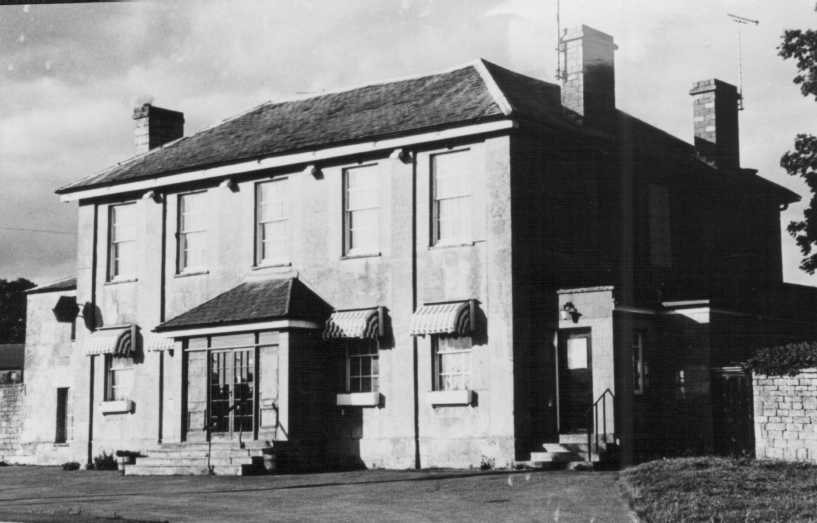
Andoversford Hotel, Station Road, Andoversford
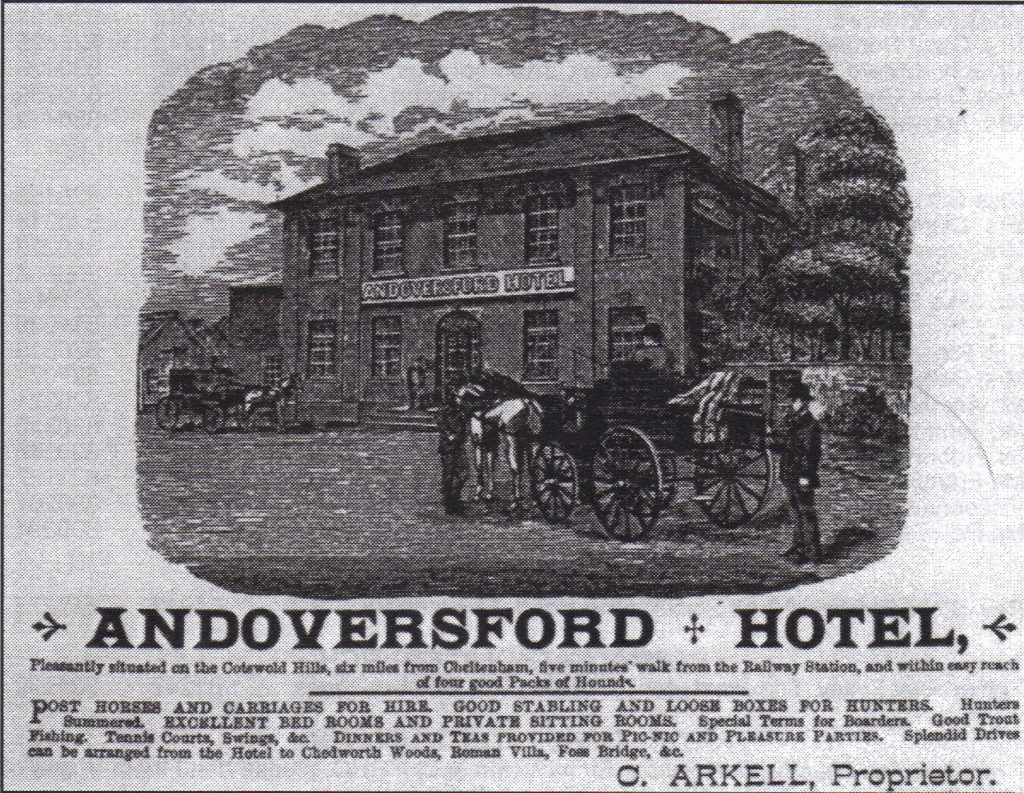
An advertisement in the 1889 Kellys Directory reads:
“Pleasantly situated on the Cotswold Hills, six miles from Cheltenham, five minutes from the railway station, and within easy reach of four good packs of hounds. Post horses and carriages for hire. Good stabling and loose boxes for hunters. Hunters summered. Excellent bed rooms and private sitting rooms. Special terms for boarders. Good trout fishing. Tennis courts, swings, etc. Dinners and teas provided for picnic and pleasure parties. Splendid drives from the hotel to Chedworth wods, Roman Villa, Foss Bridge, etc. C.A. Arkell, proprietor.”
Gloucestershire Chronicle, 19th August 1848:
Thomas Daniels, 20, and William Daniels, 48, father and son, were indicted for stealing from the pond of Sandywell Park, a quantity of carp, the property of Samuel Hitch M.D. Mr Cooke prosecuted, and Mr Skinner defended the prisoners.
The evidence against the prisoners went to show that the fishpond was drained on the night of the 30th of June last, and a large quantity of carp stolen. A poker was found by the sluice-gate, with which it had been raised. This was identified as belonging to the Andoversford Inn, where the prisoners had been drinking at half past 10 o’clock on the night in question.
The next morning the younger prisoner sold a large quantity of carp to a man named Hitchen in Cheltenham. Before the magistrates, the younger prisoner confessed the part he took in the transaction, and the elder prisoner also made admissions. It appeared that Police Sergeant Bick, who apprehended the prisoners, had used the system of pumping in order to get hold of evidence.
The Court condemned the system as both illegal and immoral.
Mr Skinner made a very able defence for the prisoners, in which he particularly tried to exculpate the elder prisoner.
His Lordship summed up the case, after which the jury consulted for a few minutes, and found both prisoners guilty.
His Lordship recalled Dr Hitch and questioned him respecting the character born by the prisoners in the neighbourhood.
The Dr. said the elder Daniels had been gardener at Sandywell and was so when he took the premises. He discharged him. Since then, he was continually missing things from his garden, and he had every reason to suspect the prisoner, who was well acquainted with the premises. He had no doubt the father had induced him to join him in draining the pond and stealing the fish.
The sentence of the court was that the elder prisoner be confined for eighteen months, and the younger one for six months.
Gloucestershire Chronicle, 11th April 1946 – Child murder and attempted suicide at Syeford, near Andoversford:
The neighbourhood of Andoversford became on Saturday last the scene of a most distressing domestic tragedy, resulting in the murder of an infant child, named Mary Newman, by her mother, a married woman, who also attempted her own life, and well-nigh succeeded in rushing into the presence of her Maker, in a state of the most fearful guilt. The circumstances of the case have awakened the deepest interest and commiseration in the neighbourhood, chiefly because they were attended with peculiarities which are happily of rare occurrence. An inquest was held at the Andoversford Inn, on Tuesday, before John Barnett, Esq, coroner, which lasted from about one o’clock p.m. until after twelve. We copy the following details from the Cheltenham Chronicle: –
“A married woman named Mary Ann Marchant, the wife of a labouring man, of Sevenhampton, deposed that she was a near neighbour of Jane Newman, the mother of the deceased, and that she had had known her for about twelve years, about which time she was married to the father of the deceased, John Newman, labourer. Husband and wife, with their five children, including the deceased infant, who was about five months old, resided during the whole of the time mentioned in the same house with is relatives, who consisted of his father, James Newman, and two sisters, Elizbeth and Jane Newman, the latter of whom was an invalid.
On Saturday morning last between eight and nine the mother of the deceased called at the deponent’s cottage, and left three of her children in her care, leaving some barley bread for them at the same time, as also some dripping to put on it; she had her infant in her arms at the time, and told deponent she was going to Dowdeswell. She seemed distracted in manner and declined taking shelter in the deponent’s cottage, though it was raining hard at the time. Deponent saw no more of the deceased nor of the mother until twelve o’clock that day, after both had been taken from Syreford mill pond, and were placed at the Syreford Inn. From what she had heard of the circumstances of the Newman family deponent could not say how they treated the mother of the deceased, but on one occasion, about a fortnight before, she complained that her husband had struck her severely on the head and had caused her to become very deaf. The deponent could not state anything further connected with the enquiry.
“Mr Samuel Dyer, of Syreford Mill, deposed that a little before nine on Saturday morning, he had occasion to go to his mill pond to look at the water, and while there his attention was attracted to what he at first supposed to be something floating on top of the water, about six feet from the bank. At that particular place the water was not more than fifteen inches or so deep, but there was a bottom of mud of considerable depth. In order to observe better what was going forward, Mr Dyer went to an elevated spot from which he had a good view, and he could then clearly perceive a woman standing in the water and mud up to her waist. She was evidently plunging something into the water, and from the fact of some clothes being on the bank close at hand, he concluded that she was trying to drown some human being. She was in an erect position, and was bending forward, keeping her hands and arms under the water. At this time she did not plunge her whole person into the water, but she proceeded in a moment afterwards into a deeper part of the stream, and threw herself forward, stretching her arms out as though she was trying to drown herself. All this occurred in a very few minutes, and the witness, as soon as he fully understood the matter ran for assistance. After some delay in getting a small boat out, a man put off from the bank, and succeeded in fastening a rope to the wretched woman’s arm, when she was drawn out quite insensible. She gave one groan when taken out, but betrayed no other signs of life, being quite motionless from the beginning.
From the bank the witness saw the body of a child lying in the water, just about the place he first observed the woman plunging her arms under the water. When taken out the child was quite dead. Mr Dyer said his impression was, from all he saw, that the women in the first instance was drowning the child and that she afterwards attempted her own life. He immediately despatched a messenger on horseback to Charlton Kings for Mr Carey, surgeon, and he also caused the woman and child to be carried up on the on a hurdle to the Syreford Inn, where effort was made to restore the latter by Mrs Denley the landlady. He picked up on the bank of the pond the outside clothes of a woman and a child. Mr Carey arrived at the inn between eleven and twelve o’clock, and succeeded in restoring animation to the woman, whom deponent knew to be Jane Newman, the mother of the deceased infant Mary Newman.
“Several other witnesses were then examined, including the father of the deceased, his sister Elizabeth, the elder Newman, and the medical man, Mr Carey. After considerable difficulty and a most protracted examination, the coroner succeeded in eliciting from the relatives of the deceased and other of the witnesses certain admissions, which tend in a great degree to account for the state of mind in which the wretched mother was at the time she perpetrated the rash act. Her husband and his relatives throughout the enquiry betrayed the most obdurate determination not to admit a syllable if possible calculated to palliate the offence of the mother or bring to light their own ill-treatment of her.
They admitted however that Jane Newman had been frequently ill-used even to blows by her husband and his sister. On one occasion he beat her with a portion of a flail, and on another struck her twice with his clenched fist on the head. The sister not only frequently quarrelled with and struck her brother’s wife, but also beat and ill-used her children, for the purpose, as she was forced to avow, of driving them from her father’s house to a separate residence.
The poor woman was ultimately made wretched beyond endurance, and she appears to have been meditating the step which ended so fatally for some time before she proceeded to put her intentions into practice. She frequently complained to her neighbours of the miserable life she led in the house with her husband and his relatives, and after her recovery from her almost drowned condition, she begged of those who were about her to do anything with her rather than take her back to the home which she so much dreaded.
Mr Carey in his evidence touching the cause of deceased’s death stated that he had not the slightest hesitation in saying it was caused by drowning, inasmuch as all the symptoms accorded with those usually attendant upon such cases. When the evidence closed the jury after a consultation of considerable length recorded a verdict of “wilful murder” against Jane Newman.
The Jury were so strongly impressed with the cruel treatment the unfortunate woman had of late experienced that they handed in a document referring to the circumstances in extenuation of the offence, and in a very strong recommendation of her case for merciful consideration later. Doubtless the Coroner will use this in such a way as he may deem most advantageous for the forlorn and unhappy prisoner.
With thanks to Dr Martyn Beaufort for the above research.
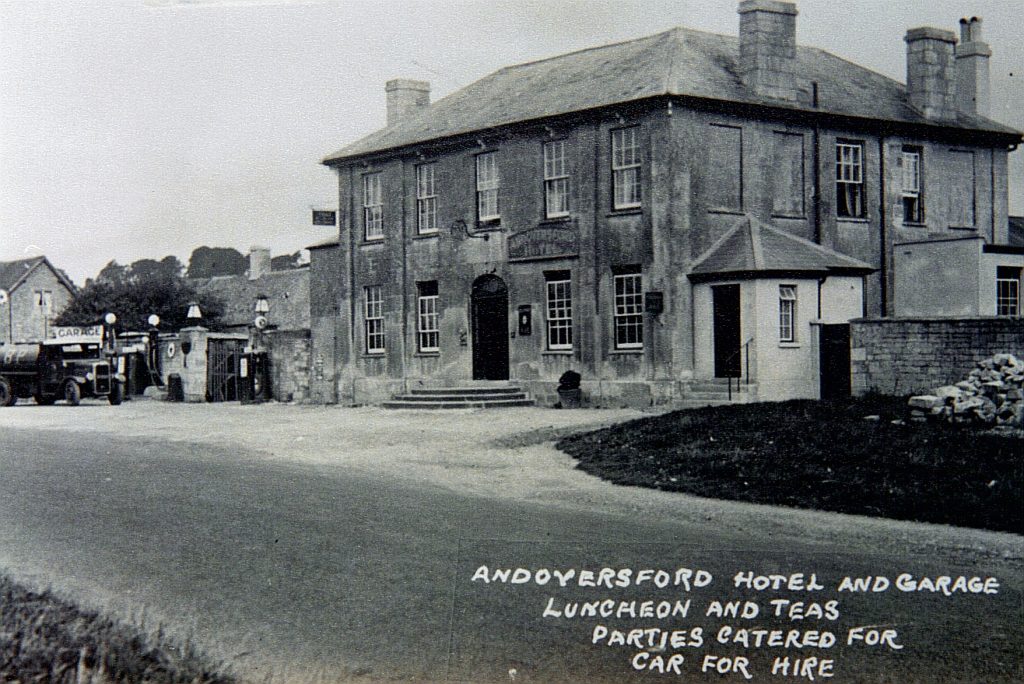
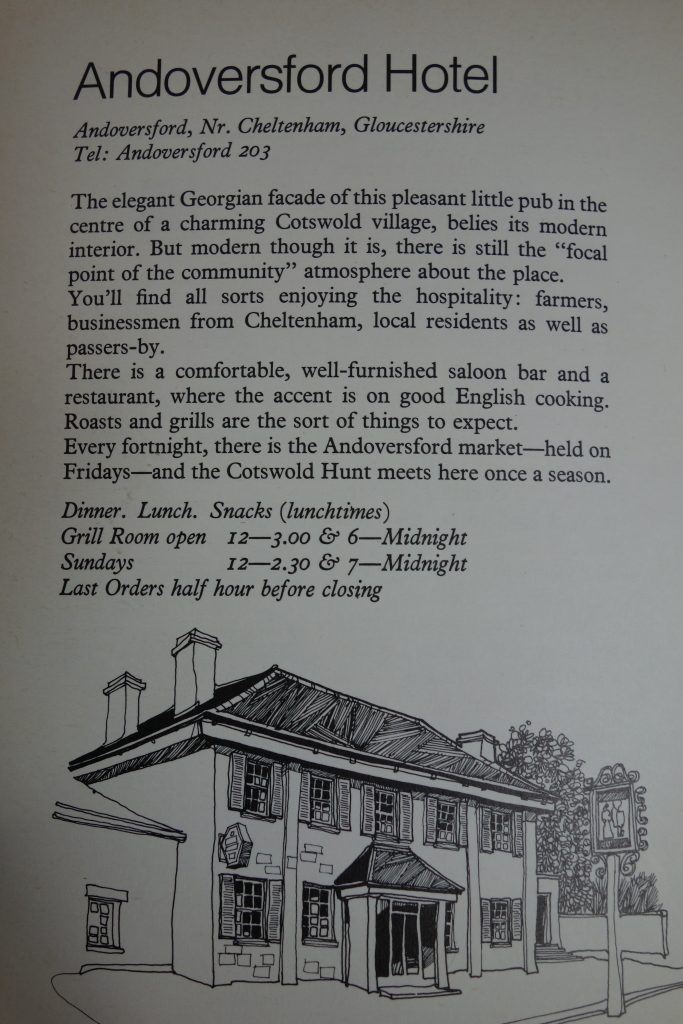
Courtesy Joe Stevens‘Inn and Around – 250 favourite Whitbread pubs’. (Whitbread Publication 1974) Gloucestershire Echo, Monday 28th April 1986 – The Andoversford Hotel (advertisement): Situated just off the A40 The Andoversford Hotel has an elegant Georgian facade, which belies its modern, well furnished interior. Excellently run by our chef, Mr Marklow, who offers a superior menu. Restored to its former glory with first class food, first class service, first class everything! The hotel can now accomodate up to 18 people and caters for wedding receptions, offering a FREE video service at the reception. It also boasts extensive gardens for those special wedding photographs.
Gloucestershire Echo, Tuesday 30th December 1986 – A Hotel for all occasions: The Andoversford Hotel, right in the heart of the village, which started life as a lovely Georgian house, has had a new manager in recent months, who is intent on making it just the sort of place for a private function, or for a pleasant drink and a meal. Simon Taylor, the new manager, took over in the early days of September, having had considerable experience in the catering and licensing trade.
Now he is keen to build up the private functions business, particularly for weddings and similar affairs, and the hotel has two splendid rooms for such events, catering for up to 120 guests, but small parties can also be accommodated.
Entertainment is provided several nights a week for customers, with traditional jazz on Sundays and Country and Western on Mondays, and there are lots of plans for future entertainment, including a gentleman’s evening in January.
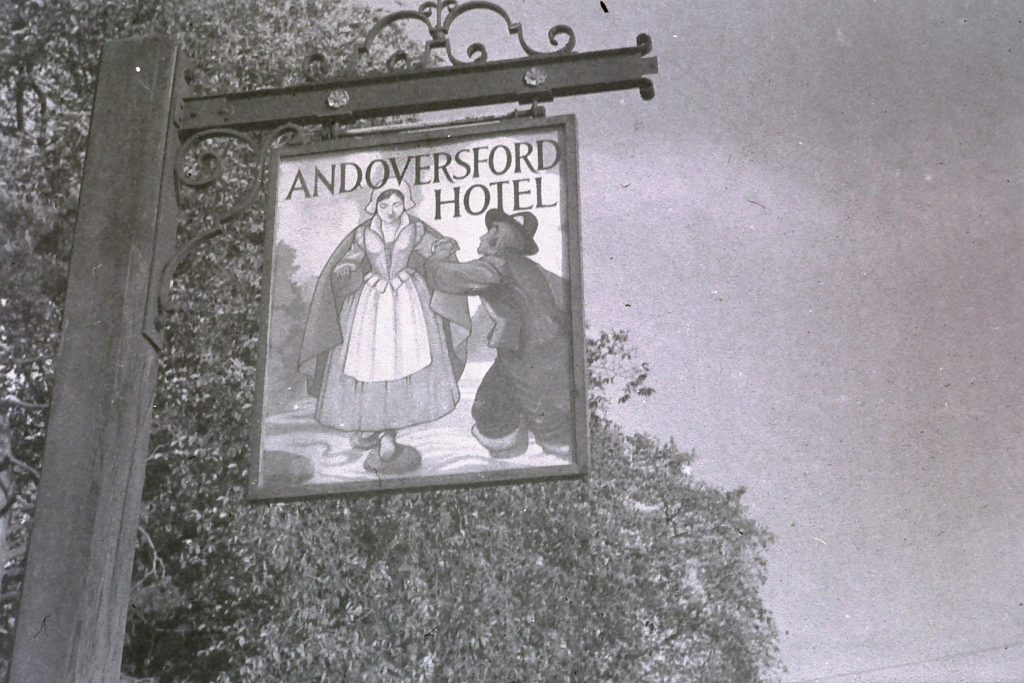
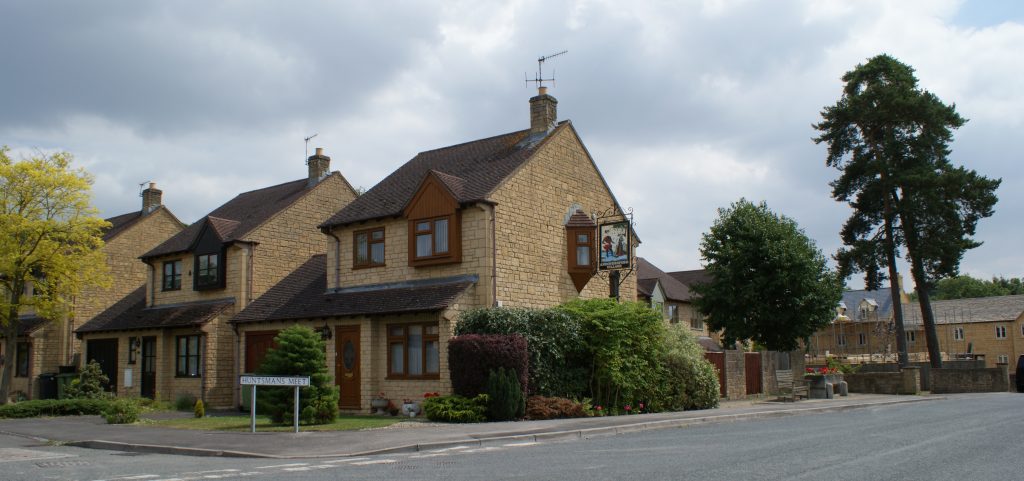
Huntsman’s Meet – the site of the Andoversford Hotel. Note the village ‘pub sign’
Gloucestershire Echo, Friday 23rd September 1988 – Save our village pub plea: by Jo Beckerley.
An angry group of Gloucestershire villagers are to fight plans to knock down their treasured local pub. Andoversford residents packed a protest meeting called in an effort to halt plans by the Whitbread brewery to build 19 homes on the Andoversford Hotel site. Parish council vice-chairman Mr Alan Lawrence, said local feelings were running high, and more than 80 people went to the meeting to back the campaign.
Mr Lawrence said: “The hotel is steeped in history and has always been a focal point in the village. We don’t intend to lose it if we can help it.” He added, “There is also a superb marble horse trough outside where the first Royal Mail coaches stopped to water the horses.”
Now the council is seeking legal advice to try and freeze the planning process and give people time to voice their objections. Mr John Haines, parish council chairman, said nobody blamed Whitbreads for closing the hotel two months ago because of poor business. But he said if development had to go ahead, it should be a conversion of the site, and not demolition. An outline application went before Cotswold District Council this month, but planning bosses decided to put off a decision and advertise Whitbread’s proposals. “They have made a special case of it because of local opinion,” said Mr. Haines.
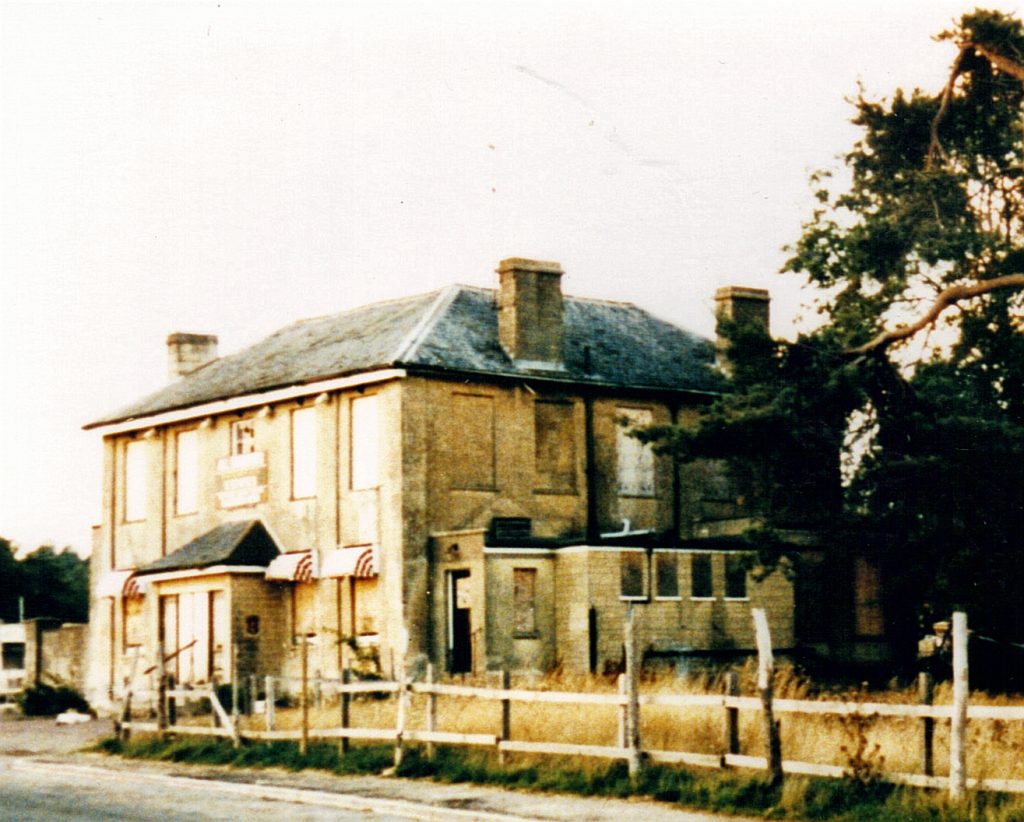
The Andoversford Hotel became known as ‘jinxed’ after a series of incidents. In March the restaurant suffered £100,000 worth of damage in a fire, theives have struck twice, the sink and bath sprung leaks, and manager Andrew Crump suffered an electric shock.
A Whitbread spokesman said: “Whitbread has put in a planning application to build 19 houses on the site of the Andoversford Hotel. If granted, the hotel would be demolished. The application follows a fire at the hotel in March. Investigations have shown it would be too costly to restore the hotel to a sufficient standard to meet today’s market. A definite decision will be made on the future.”
‘A Hippy New Year’, Tuesday 27th December 1988: Squatters are planning to see in the New Year in luxury after taking over a Cotswolds hotel. The recently-closed Andoversford Hotel near Cheltenham became home to a family of four hippies just before Christmas – and yesterday they invited others to join them. But brewers Whitbread, which owns the hotel, is planning legal action later this week to have them evicted.
The squatters have been taking full advantage of the spacious eight-bedroom hotel, and have even put up an 8 ft Christmas tree. Other hippies were reported to be on the way to the hotel to join the New Year celebrations.
From the Hartlepool Northern Daily Mail
Gloucester Journal: Monday, 20th August 1990: One of the Cotswolds’ oldest hostelries and market meeting places, the Andoversford Hotel, has been sold by local agents Young & Gilling Commercial on behalf of Whitbread Estates – a division of Whitbread Plc. A representative of Young & Gilling, Micahael Sanderson, reported that the property had been sold for around £1/2 million. The purchaser David Deacon Developments intend to build some eighteen natural stone village homes on the site.
Licensing Details:
Owner in 1891: C.W. Lawrence (leased Cheltenham Original Brewery)
Rateable value in 1891: £63.0s.0d. included a cottage and one and three quarter acres of land
Type of licence in 1891: Alehouse
Owner in 1903: C.W. Lawrence (leased Cheltenham Original Brewery)
Rateable value in 1903: £63.0s.0d. included a cottage and one and three quarter acres of land
Type of licence in 1903: Alehouse
Closing time in 1903: 10pm
Landlords / Proprietors at the Andoversford Hotel include:
1856 W. Slade
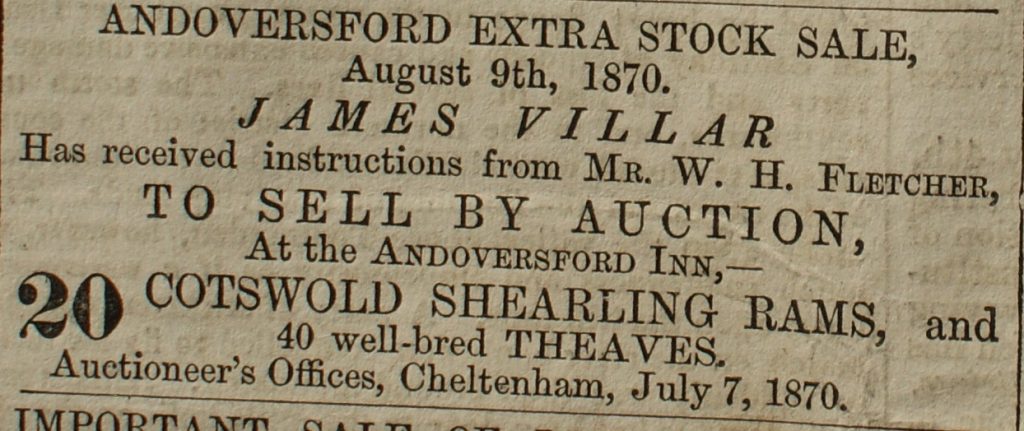
1870 Mr Sparrow
1885 Emily Collingwood Colman
1889, 1896 Cotterell Arkell (Liabilities of £812 in 1896. Twenty-five unsecured creditors. His wife argued that ‘everything in the house belonged to her’ – Cheltenham Chronicle 28.03.1896)
1903,1919 George Felix Smith
1927 Eustace Felix Smith
1940 Frank Arthur
1947 Mr and Mrs J. Cooper (late of the Star Hotel for over 16 years)