The Merrymouth Inn, thought to be the only pub having that name in Britain, is in an isolated location on the A424 between Burford and Stow-on-the-Wold near the small village of Fifield. It is in the county of Oxfordshire, just over the Gloucestershire border.
The Merrymouth Inn has served travellers on this Cotswold road since the 13th Century, possibly around 1260AD. In the 14th century the building was part of the Murimuth family estate and was named The Murimuth Arms. There are rumours of escape tunnels built in 16th century during the Reformation that run from the Inn’s vaulted cellars found at the north end of the building to the nearby Abbey. There are reports of the notorious highwaymen Tom, Dick & Harry Dunsdon from Fulbrook frequenting the Inn in 18th century.
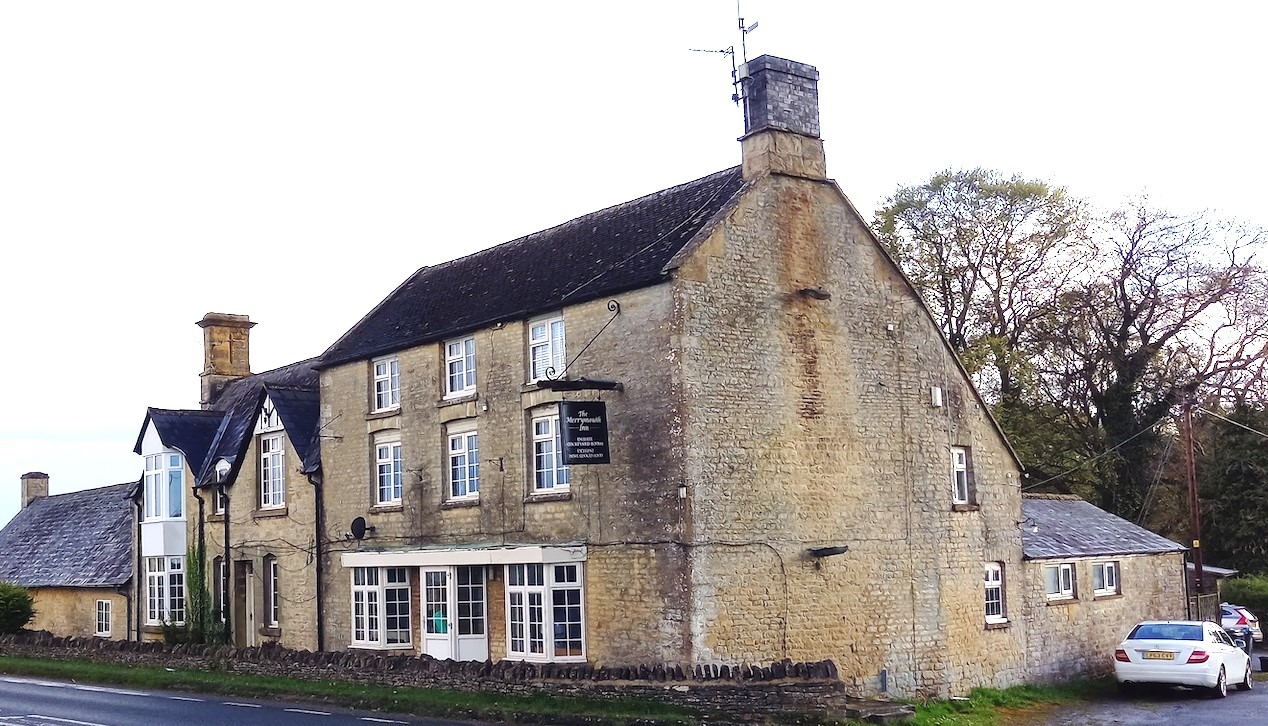
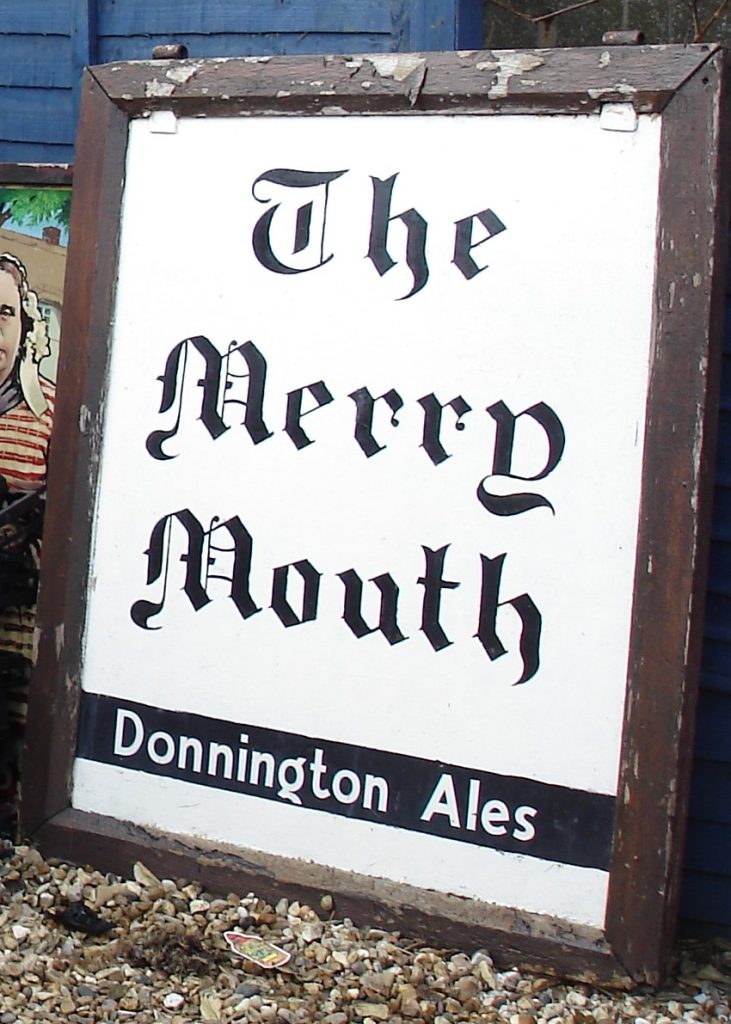
The farm, stables, barn and the Hunters Lodge were built between 16th and 17th Centuries and the reception area and kitchens were added more recently in 1960’s and 1970’s to link the courtyard & carpark to the rest of the Inn. The Merrymouth Inn was then tied to the Donnington Brewery of Stow-on-the-Wold.
At the time of writing (November 2025) the Cotswold Merrymouth has taken the decison to close their food and drink business for several months while they undertake some major renovations and reshape and invest in the business to “mitigate the extra costs and regulations passed down by the UK Government on 6th April 2025.” The accommodation and hotel facilities continue to operate as normal. However, on every third Thursday of the month the bar and restaurant is the home of the Cotswold Blues Club (see the calendar on their website for future events including the ocassional darts night hosted at the pub).
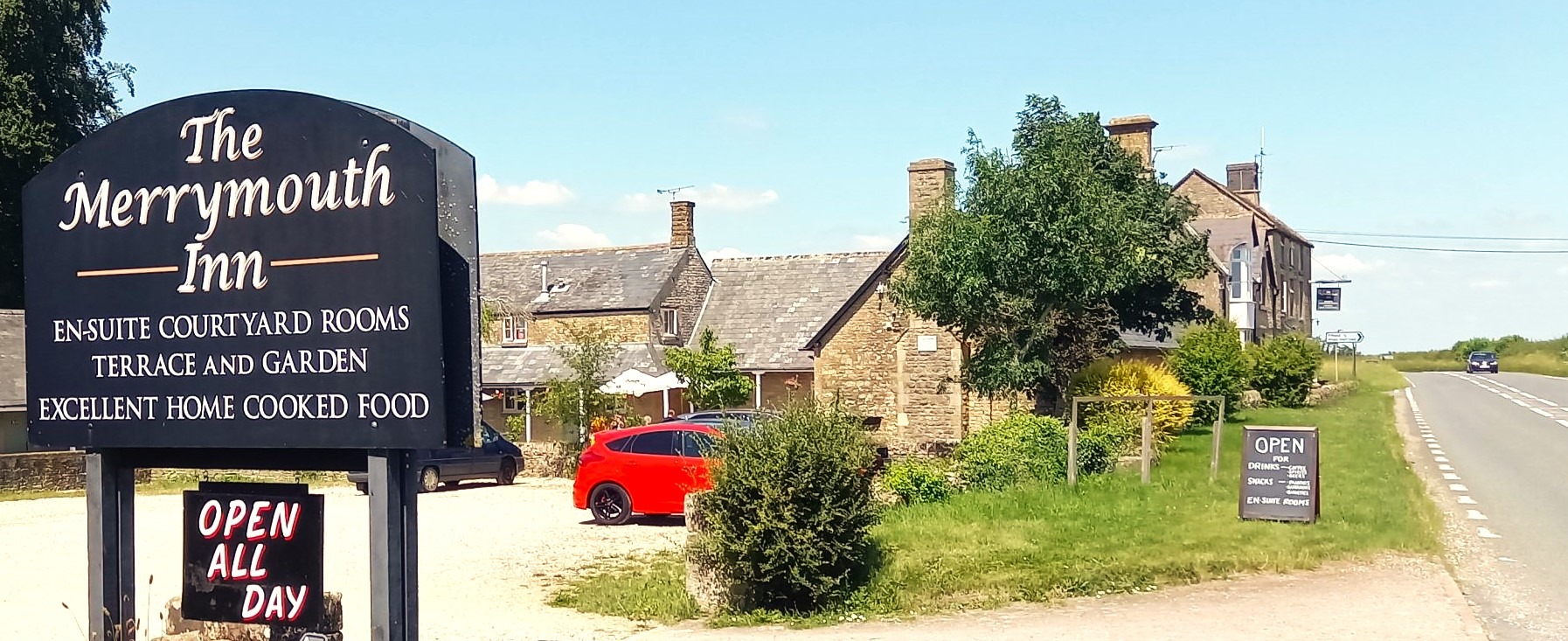
https://cotswoldmerrymouth.co.uk
Oxfordshire Weekly News, Wednesday 23rd October 1895 – Inquest of an infant: On Friday an inquest was held at the Merrymouth Inn, Fifield, before F. Westell, Esq., coroner, on the body of a female child, aged seven hours, belonging to Frederick Painting, cowman for Mr Matthews, of Fifield. The jury, of whom Mr Daniel Davis was foreman, after hearing the evidence of Harriett Basldwin (midwife), Ann Williams, and Dr. Turner, of Milton, returned a verdict of death from inanition, which existed from the childs birth.
Oxfordshire Chronicle and Reading Gazette, Friday 9th July 1920 – To Let, by Tender: from Michaelmas 1920, old-established Country Inn called the Merrymouth, Fifield, with lodge attached, together with the Warren Farm adjoining and two cottages for workmen. Total acreage 293 acres, 248 arable and 45 pasture.
The “Merrymouth” Inn and Lodge are beautifully situated on the main road from Stow-on-the-Wold to Burford at the head of Fifield village, and command magnificent views. The inn is fully licensed for six days only. Shooting reserved by Landlord. The property can be viewed at any time on application to present tenant, Mr William Evans.
Gloucestershire Echo, Tuesday 27th July 1920 – On Wednesday 22nd September at the Merrymouth Inn, Fifield, Oxon – sale of household furniture and effects, by order of the late Mr James Evans.
Oxfordshire Chronicle and Reading Gazette, Friday 25th April 1924 – Fifield farmer’s affairs:
The public examination of Arthur Henry Foddy, “The Merrymouth Inn,” Fifield, Oxon, farmer and licensed victualler, will be held on Monday next, at the County Hall, Oxford. The deficiency estimated by debtor is £769.1s.11d. The causes of failure alleged by debtor are: “Want of capital, bad seasons during the last three years; and loss of horses by death which I could not replace.” The Official Receiver observes that prior to November, 1920, the debtor was employed as a skilled workman at the L. & N.W. Railway works. At that date he commenced to trade as a farmer and licensed victualler with a capital of £300, representing his savings. The farm which the debtor took in his own name is about 315 acres, of which only 46 are pasture, at a rental of £200 a year. The debtor was evidently quite inexperienced in farming, or he would never have dreamed of hoping to successfully cultivate such a farm with a trifling capital of £3OO. He induced his sons to help him in this enterprise, and one of them lent him £2OO, with an understanding that if the business prospered he would take him into partnership. Now that recent years have been adverse, the want of capital became acute, and appears to be the main cause of failure. I have declined to carry on the public house, and have arranged with the landlord to take tp the fixtures, etc., in exchange for their cash value. The debtor had two wagons and a binder on hire-purchase, which he obtained about two years ago. These he returned on April 1st. He states the owner’s name plates were upon them, and that they were not in his order and dispositions. This transaction needs investigation. The debtor has also parted with hay under conditions which require investigation. The debtor has kept no books of account, and admits knowledge of insolvency about a year ago. The largest asset of £4OO, growing crops and tenant right, is a doubtful asset, as there are considerable arrears of rent, and the dilapidations have not apparently been taken into account. The landlord will probably claim to set off what is due to him on these accounts against the value of tenant right. Of the unsecured indebtedness, £323.8s.6d. is for arrears of rent, £280 for money lent; £396.10s.11d. bank overdraft (guaranteed); the remainder being for trade goods and expenses. These debts were contracted between 1921 and 1924. He has lodged no proposal.
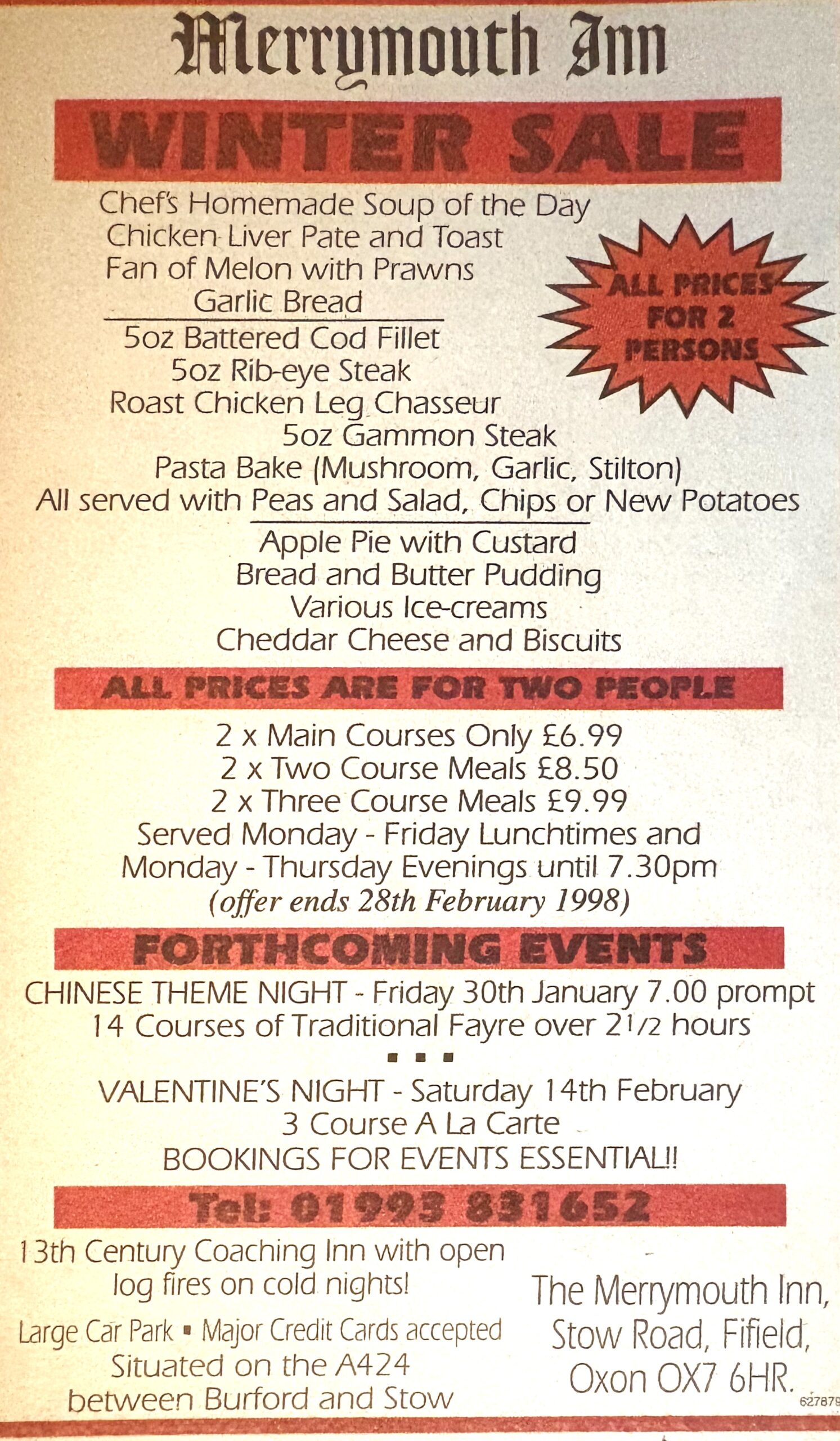
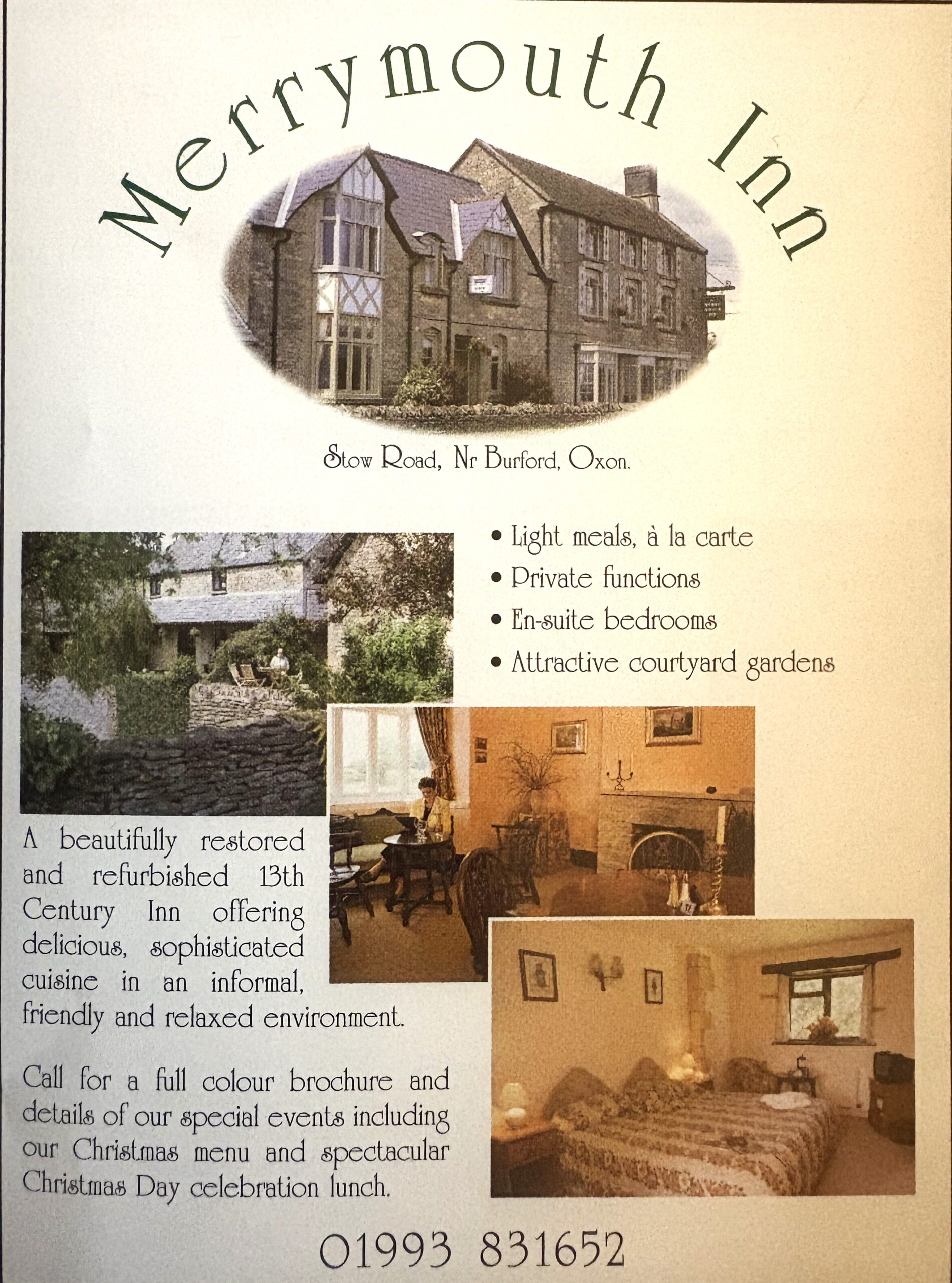
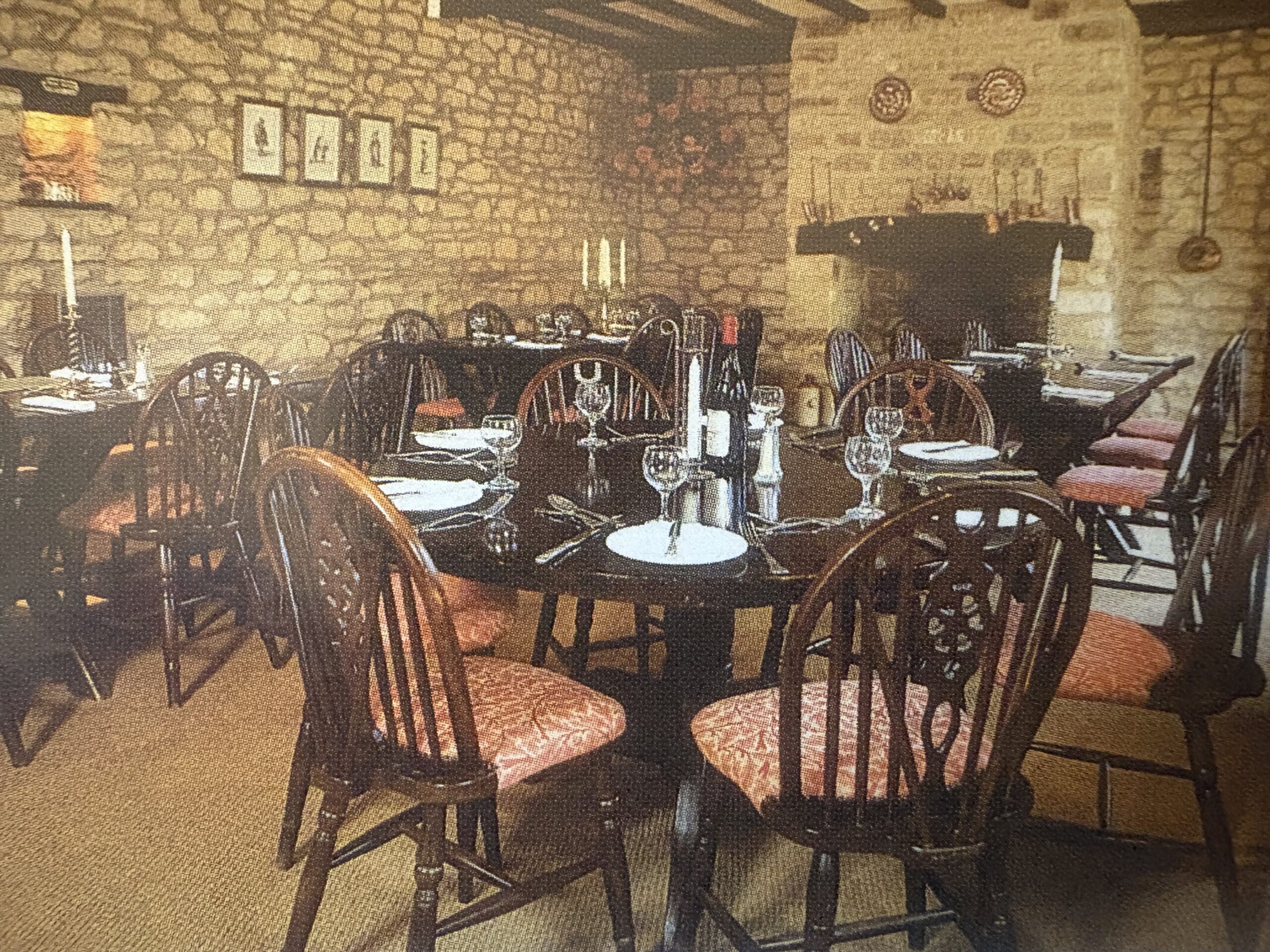
Wilts & Gloucestershire Standard, 18th February 1999 – Locals are in for a meal treat: The Merrymouth Inn on the Stow-Burford road has just been taken over by two brothers, Andrew and Timothy Flaherty. The brothers have worked together in the hospitality industry since they left school and started work in their parent’s hotel in Surrey. They have run pubs and hotels all over the country and recently ran a hotel in Gers in the south of France for two years.
Andrew (38) who deals with the front-of-house service, said they had always wanted to run a hotel in the Cotswolds. “It’s just such a lovely area and when we both saw the Merrymouth we know it was right for us,” he said.
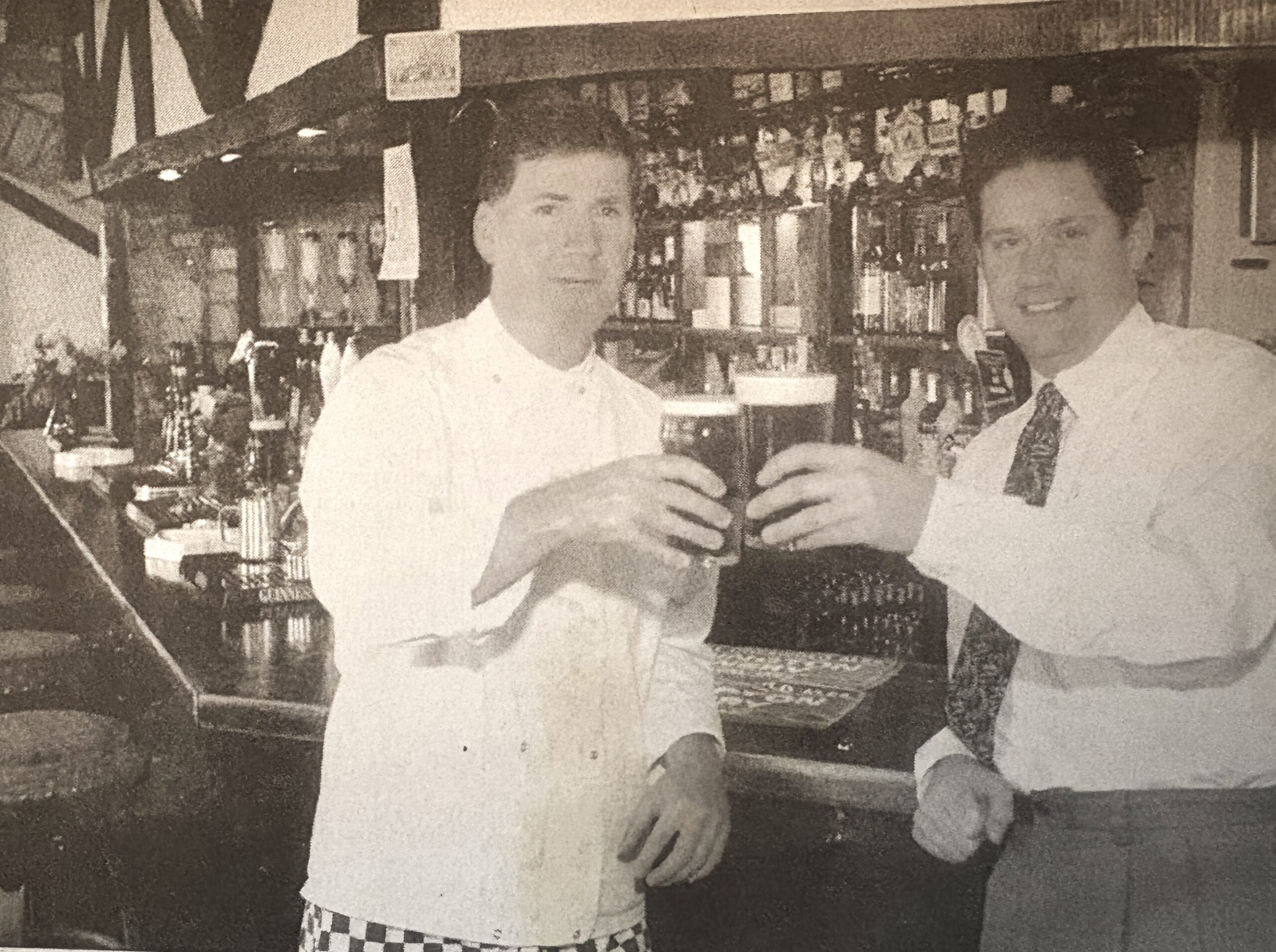
Above: Brothers Timothy, left, and Andrew Flaherty (photo: Standard 18.2.1999)
Witney Gazette, Saturday 22nd February 1908 – “By the Way” Columnist
The other day, I chanced to be at a meet at the ” Merrymouth,” which well-known inn is a favourite fixture of the Heythrop hounds. Very handsome did the huntsmen, hounds and horses look on the day I saw them. Of course, hunting and such kindred enjoyments have always been far away from me, and yet I always think there is something wrong in the composition of those who do not like this excellent sport. For, as an old huntsman used to say, “the ‘osses likes it. I be sure the dogs do, and most men and women, and as for the fox, well, I never yet heard o’ one objecting, so we can’t be so very wrong in following it.” Yes! everything did look well on that fine February morning, but when the hounds had become lost in Tangley woods I began to look at the old house itself, and to wonder in particular how it acquired its name “Merrymouth.” “Merrymouth,” I repeated, surely there is no physical feature to account for the name. And is usual with me if I can get no reply in this direction, I turn to matters of history, and see if this will supply an answer to my question.
In this case the answer was soon forthcoming, for I find that so early as 1312 John de Murumuth was Lord of the Manor, and since there are remains of foundations at the back of the inn, perhaps his mansion stood at this very spot. The descent from ” Mururnath ” to ” Merrymouth” is easy, and in fact one wonders why in so many centuries the name has not changed more than it really has. Undoubtedly this inn acquired its name from the fact of the Murumuths living here or in the parish. That being so, and having regard to the circumstance that this family left the village certainly before the 15th century dawned, I think we may be justified in assuming that this inn is one of the most ancient in England. No doubt it existed at a time when there was merely a baggage road from Burford to the North, since the present turnpike road was laid down as late as 1798, and in any case, the ” Merrymouth ” stood here at the period when that great heath existed, occupying almost all the country between the inn and Burford.
What a history the “Merrymouth ” must have! What could not the old walls of the building record if they could but speak! They have seen many and many a scene of importance without doubt. Most certainly, they saw the army of the broken-hearted monarch, Charles I, pass on its way to Stow and beyond. I wonder did the King himself stop here, or did he ride past surveying it only with those mournful eyes of his as he went along on his wearied, distracted way. Who can tell!
I know nothing either of the doings here in the days when the highways wore infested with robbers. Tradition says a band lived in a cave at Tangley close by, and as you all are aware to this day, a doorway is pointed out at Tangley Hall in which it is said one of these robbers was seized by the hand through a hole by those inside. You know, too, that the robber is said to have consented to having his hand cut off by his comrades, leaving his hand in the grasp of those who had taken hold of him on the other side, rather than be taken.
But those were old times, times rougher than our own, and this old house has long settled down to a prosaic existence. The Heath (Blackheath it was called) is gone long ago, only a clump remains, though it is said that you can see 16 market towns from it, and the face of most things has changed, and for the better. There it stands as it has done for centuries, and I am bound to record that you will meet with no better place for attention to creature comforts than you will here. Healthy spot did you ask? I know of none more so. It stands 610 feet above the sea level, and if anyone cannot, after taking a walk in the country around, do justice to the good things the hostess will provide if you wish, well, then his case must be hopeless indeed.
I must not forget to mention that before the time named, viz 1314, there was one of the family of Muromuth, who was rather a distinguished personage. I refer to Adam de Murumuth, priest and envoy extraordinary, of Rome, who was born in 1275 and took his degree of D.C.L. at Oxford in 1312.
Landlords at the Merrymouth Inn include:
1857 Mr Clifford
1883 George Clifford
1904 Mr. Evans
1920 (Nov.) ‘The licence of the Merrymouth Inn, Fifield, was transferred from William Evans to Christopher B. Chambers.’
1924 Arthur Henry Foddy
1998 Jenny and Leo
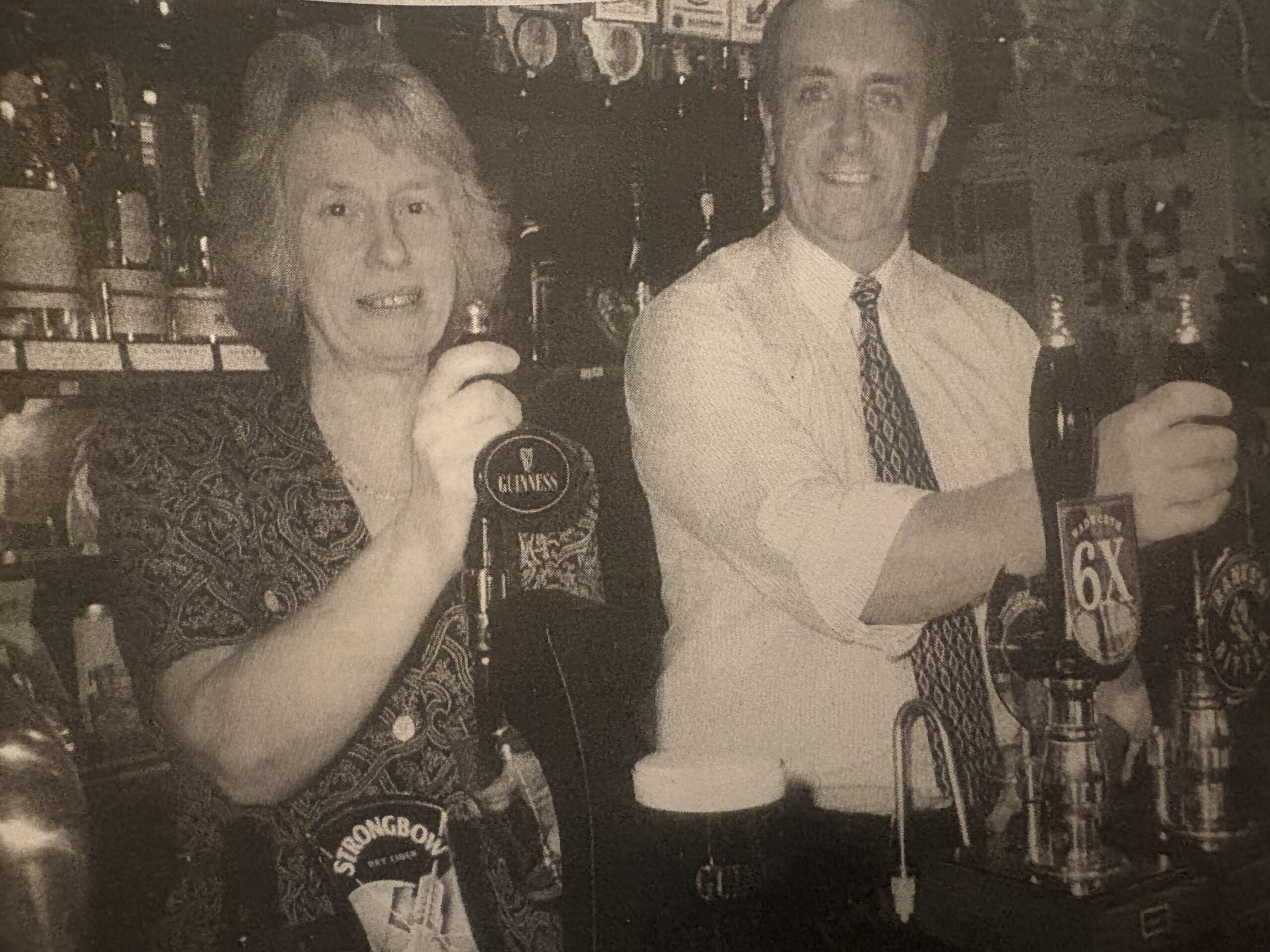
1999 Andrew and Timothy Flaherty